
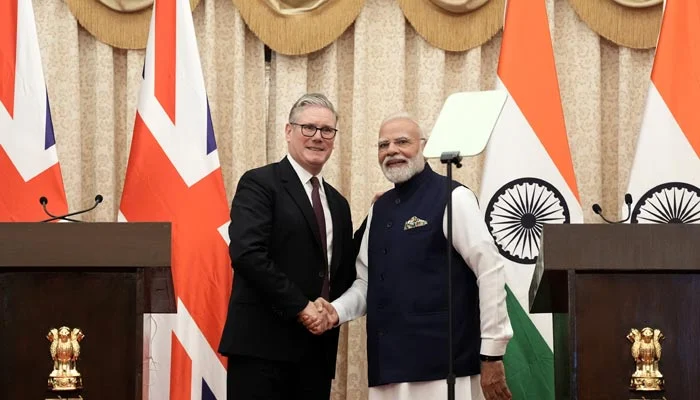
British Prime Minister Sir Keir Starmer and Indian Prime Minister Narendra Modi praised a new phase of cooperation between India and the United Kingdom, highlighting their recently signed trade and defence agreements as transformative for both nations’ economies.
During a joint press conference at Raj Bhavan in Mumbai, Modi said that relations between the two countries had made “significant progress,” adding that the trade accord would reduce import costs, create jobs, and boost bilateral trade.
“This agreement will reduce import costs between our two countries, create new employment opportunities for youth, boost trade, and benefit both our industry and consumers,” Modi said, calling Starmer a “friend” and describing his visit as a symbol of “new energy” in bilateral ties.
The comprehensive trade agreement, signed in London in July, will see India cut tariffs on British goods such as cosmetics and medical devices, while the UK will lower duties on Indian clothing, footwear, and food items, including frozen prawns.
Starmer, on his first visit to India as prime minister and accompanied by a 125-member trade delegation, said he expected the deal to bring “major new investments” and create thousands of high-skilled jobs in both countries.
“India’s growth story is remarkable,” Starmer said. “Everything I’ve seen since I’ve been here is absolute proof that you’re on track to become the world’s third-largest economy by 2028 — and we want to be partners on that journey.”
The two leaders also announced a defence cooperation pact and new education initiatives, including support for nine British universities opening campuses in India.
India and the UK currently have bilateral trade worth $54.8 billion, supporting over 600,000 jobs across both nations. India became the world’s fifth-largest economy in 2022 when it overtook the UK, and it is projected to surpass Japan later this year to become the fourth-largest economy, according to the IMF.
Starmer returns to London later Thursday after what he called a “productive and forward-looking visit,” aimed at doubling the potential of the new partnership.