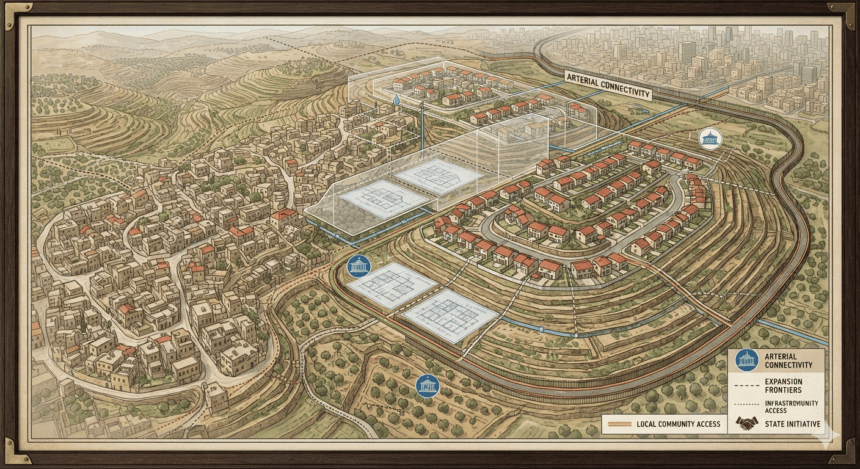
The Israeli government is accelerating construction in the occupied West Bank, defying international warnings and legal consensus. Since the current administration took office, the Higher Planning Council has advanced plans for thousands of new housing units, signaling a departure from previous policies that occasionally paused expansion under pressure from Washington.
For Prime Minister Benjamin Netanyahu, these settlements are the bedrock of his coalition. His government relies on ultra-nationalist partners like Finance Minister Bezalel Smotrich and National Security Minister Itamar Ben-Gvir, both of whom view the expansion not just as a policy goal, but as a religious imperative. By fast-tracking these projects, Netanyahu maintains the fragile stability of his cabinet while silencing critics within his own right-wing base.
The expansion is changing the geography of the West Bank. New outposts are being retroactively legalized, and infrastructure—including roads and utility grids—is being extended to link isolated settlements to the Israeli mainland. Analysts suggest this is a calculated move to make a future Palestinian state physically impossible. If the land is fractured by permanent Israeli infrastructure, the “two-state solution” becomes little more than a rhetorical relic.
The international community, including the United States, officially labels these settlements illegal under international law. However, current US policy has shifted from active opposition to cautious, often ignored, diplomatic scolding. Critics argue that the Biden administration’s reluctance to impose concrete consequences—such as conditioning military aid—has effectively given the Israeli government a green light to continue construction.
For Palestinians, the impact is immediate. Increased settlement activity is accompanied by a rise in settler violence and military restrictions on movement. Farming communities in the Jordan Valley and the South Hebron Hills report being pushed off their ancestral land as new outposts appear on neighboring ridges.
“Every new brick laid in a settlement is a nail in the coffin of any peace process,” a senior Palestinian Authority official told reporters earlier this week. “They aren’t just building houses; they are redrawing the map to ensure we have no future here.”
The government’s strategy is clear: solidify control on the ground while the world is distracted by regional security crises. By the time diplomatic pressure mounts, the new reality on the ground may be too entrenched to reverse.