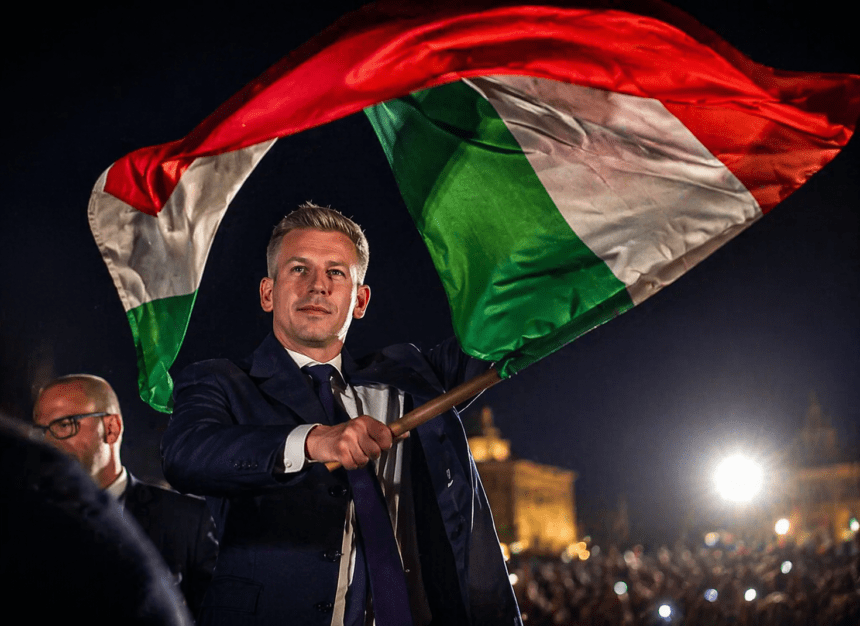
Viktor Orbán’s political era in Hungary did not fade out slowly. It ended in one jolt. In the April 12, 2026, parliamentary election, Hungarian voters removed Orbán after 16 years in power, handing victory to Péter Magyar and his Tisza Party in what even seasoned observers treated as a political earthquake. Orbán conceded defeat the same night, calling the result “painful,” while early and subsequent reporting pointed to a two-thirds parliamentary majority for Tisza.
That landslide is why the second half of the headline matters so much. Magyar is not behaving like a leader preparing for a slow, ceremonial transition. He has been pushing for a rapid handover and wants to become prime minister as early as May 5. The pace is deliberate. After years in which Orbán built a deeply entrenched system around Fidesz, Magyar is signaling that delay would only give the outgoing order more time to harden its defenses.
The speed also reflects the size of the task ahead. Orbán’s governments spent years reshaping Hungary’s institutions, judiciary, media environment and relationship with Brussels. Magyar campaigned as a pro-European conservative promising a reset rather than a revolutionary rupture in style, but the substance could still be dramatic. The Guardian reports that his team is already in informal talks with EU officials, who expect a new Hungarian government to move quickly on rule-of-law issues, corruption controls, asylum policy and academic freedoms in order to unlock frozen EU money.
Foreign policy is one of the clearest places where change may be felt early. Orbán had become the EU’s most disruptive internal ally of Moscow on several major issues, especially over Ukraine aid and sanctions on Russia. Recent reporting says Magyar is expected to drop Hungary’s block on a €90 billion EU loan to Ukraine once sworn in, and Kyiv is cautiously hopeful that relations with Budapest may improve, even if no one expects old disputes to vanish overnight.
Still, “man in a hurry” does not mean “man with an easy road.” Even with a commanding mandate, Magyar will inherit state institutions shaped by Orbán’s long rule, and replacing habits of power is harder than replacing a prime minister. Polish officials and legal reformers cited in current reporting warned that promises alone will not satisfy Brussels and that changing the mentality and operation of institutions built over 16 years will take relentless work.
So the headline rings true, with a caveat. Orbán’s era ended suddenly at the ballot box, yes. But what comes next will not be instant. Magyar has the momentum, the mandate and the urgency. What he still has to prove is whether speed can translate into durable political reconstruction in a country that has just lived through one of the sharpest democratic reversals in Europe.