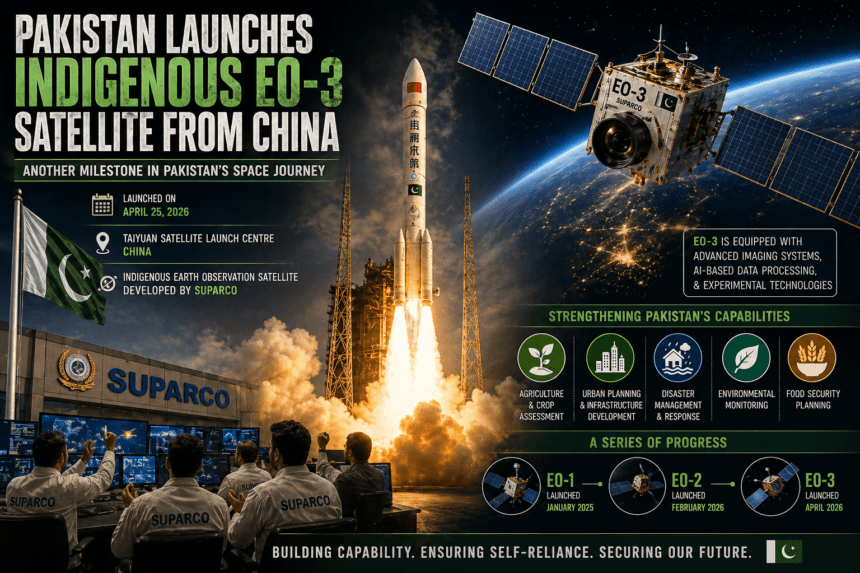
Pakistan on Saturday announced it had successfully launched its indigenous electro-optical satellite, EO-3, from the Taiyuan Satellite Launch Centre in China, marking another step forward in the country’s expanding space programme. The launch took place on April 25, 2026, and was confirmed by the Space and Upper Atmosphere Research Commission (SUPARCO).
The satellite is designed to strengthen Pakistan’s Earth observation capabilities. Officials said it will support agriculture, urban planning, disaster management, environmental monitoring and food security planning.
According to mission details, EO-3 also carries experimental technologies, including a multi-geometry imaging module, advanced energy storage systems and an onboard artificial intelligence-based data processing unit. This indicates Pakistan is not only expanding its satellite network but also testing next-generation observation technologies for more efficient data processing.
The launch comes during an active period for Pakistan’s space programme. Earlier, EO-2 was placed into orbit from China in February 2026, while EO-1 was launched in January 2025, reflecting SUPARCO’s push to develop a sustained series of indigenous Earth observation satellites.
For Islamabad, the broader significance lies in capability and continuity. While satellite launches may not dominate public attention, they play a critical role in crop assessment, land-use planning, environmental monitoring, infrastructure management and disaster response. EO-3 aligns closely with these national priorities.