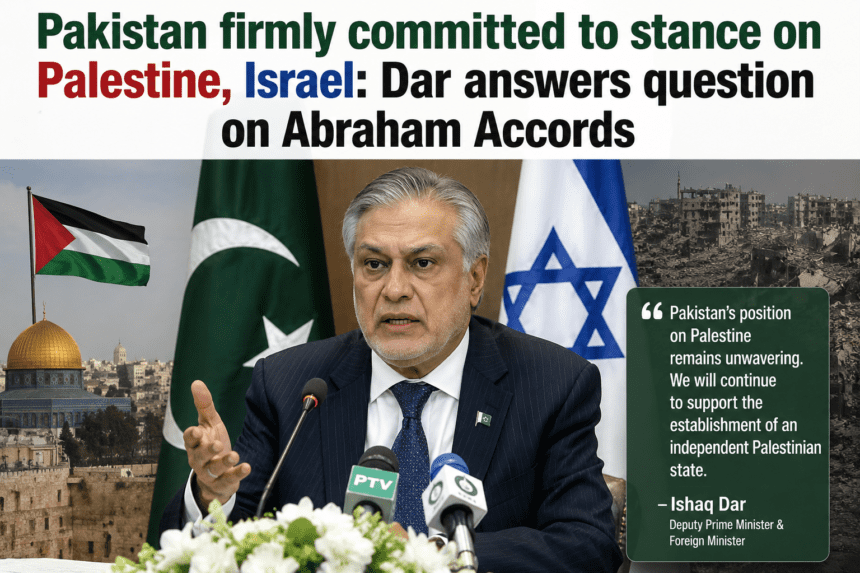
WASHINGTON: Pakistan has once again drawn a clear line on one of its longest-standing foreign policy positions, saying there will be no change in its stance toward Israel unless an independent Palestinian state is established.
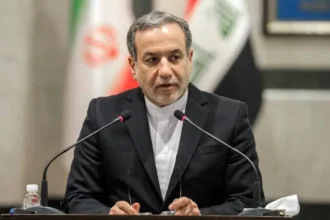
Deputy Prime Minister and Foreign Minister Ishaq Dar made the remarks during a press conference at Pakistan’s embassy in Washington after meeting US Secretary of State Marco Rubio. The comments came as questions continue to swirl around renewed American efforts to expand the Abraham Accords, a diplomatic initiative aimed at encouraging Muslim-majority countries to normalize relations with Israel.
Asked whether US President Donald Trump had stepped back from calls for countries such as Pakistan to join the Abraham Accords, Dar avoided directly addressing Trump’s latest proposal. Instead, he returned to Pakistan’s traditional position on the Palestinian issue.
“Pakistan remains steadfast in its position on Palestine and Gaza,” Dar said, stressing that Israel must move toward the establishment of a Palestinian state before Islamabad could even consider revisiting its policy.
The statement may not have surprised seasoned observers of Pakistan’s diplomacy, but it arrived at a moment when speculation was growing. Earlier this week, Trump publicly urged a group of Muslim-majority countries — including Pakistan, Saudi Arabia, Qatar, Türkiye, Egypt and Jordan — to join the Abraham Accords as part of a broader regional framework connected to ongoing discussions involving Iran.
In a social media post, Trump argued that countries participating in efforts to stabilize the Middle East should simultaneously recognize Israel under the accords. The proposal immediately triggered debate across the region, especially in countries where public opinion remains strongly supportive of the Palestinian cause.
Pakistan’s response has been notably firm.
Officials in Islamabad have repeatedly maintained that recognition of Israel is tied to a two-state solution and the creation of a sovereign Palestinian state based on internationally recognized parameters. Analysts say that position enjoys rare political consensus across Pakistan’s otherwise deeply divided political landscape. Even parties that disagree on almost everything else tend to converge on Palestine.
The Abraham Accords, first brokered during Trump’s previous administration in 2020, led to normalization agreements between Israel and several Arab states, including the United Arab Emirates and Bahrain. Supporters hailed the deals as a breakthrough in regional diplomacy. Critics, meanwhile, argued they sidelined the Palestinian issue rather than resolving it.
What makes the current debate different is the broader geopolitical backdrop.
Washington is simultaneously engaged in delicate discussions aimed at reducing tensions involving Iran, while conflict in Gaza continues to fuel anger across much of the Muslim world. That reality has made the prospect of additional countries joining the accords politically complicated, even for governments that maintain close ties with the United States.
During the Washington visit, Dar also highlighted Pakistan’s diplomatic efforts in regional mediation. According to the US State Department, Rubio thanked Pakistan for what it described as a constructive role in promoting peace and dialogue in the Middle East, including contacts related to Iran.
For now, Pakistan’s message appears straightforward: despite shifting alliances and fresh diplomatic pressure, its position on Israel remains tied to the unresolved Palestinian question.
And at least publicly, Islamabad is showing little sign that it intends to move away from that formula anytime soon.