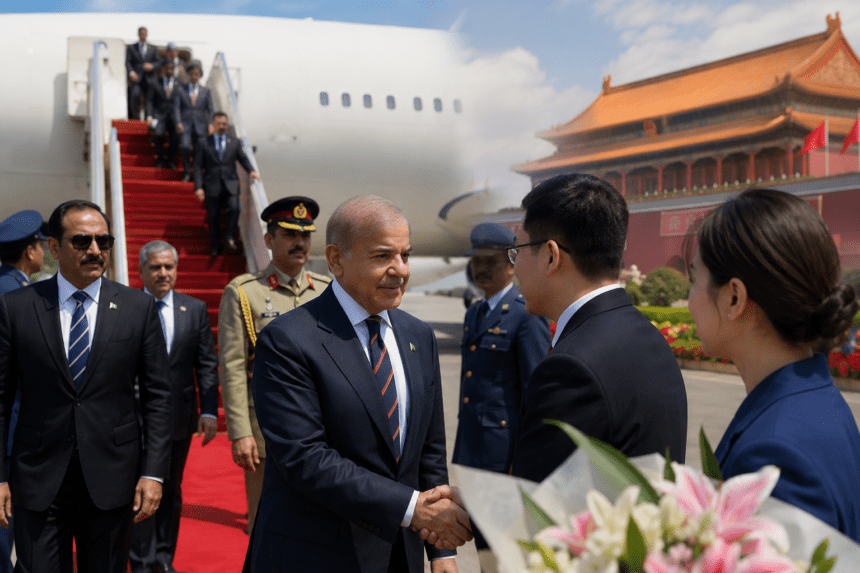
Hangzhou: Prime Minister Shehbaz Sharif arrived in China’s Hangzhou city on Saturday at the start of a four-day official visit aimed at strengthening Pakistan-China strategic ties, expanding economic cooperation and marking 75 years of diplomatic relations between the two countries.
The prime minister is visiting China from May 23 to May 26 at the invitation of the Chinese government. His first stop is Hangzhou, the capital of Zhejiang province, where he is scheduled to chair the Pakistan-China Business-to-Business Investment Conference. The visit will later take him to Beijing for high-level meetings and commemorative events.
Shehbaz is accompanied by Deputy Prime Minister and Foreign Minister Ishaq Dar, Planning Minister Ahsan Iqbal, Information Minister Attaullah Tarar, IT Minister Shaza Fatima Khawaja and Special Assistant Tariq Fatemi. The delegation’s composition reflects the economic and technology-focused nature of the visit.
According to the Foreign Office, the prime minister will meet Chinese President Xi Jinping and Premier Li Qiang during the visit. The two sides are expected to review cooperation in political, economic and strategic areas, with special focus on CPEC, trade, investment, industrial cooperation, agricultural modernisation, information technology, science and technology, and people-to-people exchanges.
The Hangzhou leg is being watched closely because of its business and technology angle. The prime minister is also expected to engage with Chinese investors and technology companies, as Islamabad seeks to draw more Chinese investment into export-oriented industries, digital services, agriculture and industrial zones.
In Beijing, Shehbaz will attend a reception hosted by the Chinese People’s Association for Friendship with Foreign Countries to commemorate the 75th anniversary of diplomatic relations between Pakistan and China. That anniversary gives the visit a symbolic layer, but the real test will be whether both sides can turn familiar promises into fresh investment and faster project delivery.
The China-Pakistan Economic Corridor is expected to remain central to the talks. Pakistan has been pushing for the next phase of CPEC, with more emphasis on industrial development, agriculture, special economic zones and technology cooperation rather than only roads and energy projects.
The visit also comes at a time when Pakistan is trying to stabilise its economy, attract foreign investment and reassure Chinese partners about project security. Beijing has repeatedly called for stronger protection for Chinese workers in Pakistan after attacks on Chinese nationals linked to CPEC and other projects.
For Islamabad, the trip is both diplomatic and economic. The message is clear: Pakistan wants China to stay deeply engaged, not only as a strategic ally but also as a long-term investor.
The prime minister’s four-day visit will conclude on May 26.