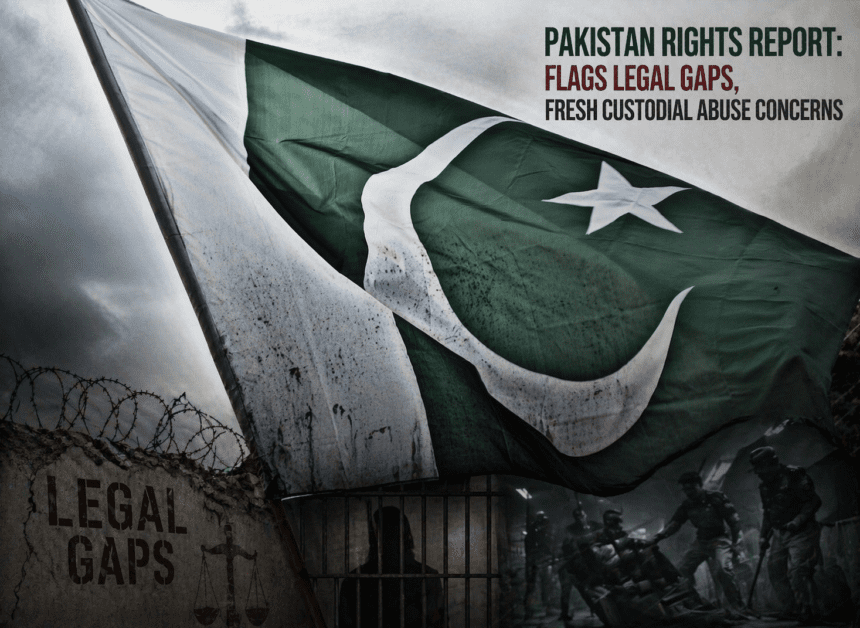
Pakistan’s human rights watchdog has told the United Nations Committee against Torture that, despite a newer anti-torture law, serious weaknesses still run through the country’s legal and enforcement system, especially when it comes to custodial abuse, police torture allegations, and conditions inside detention facilities.
At the center of the story is Pakistan’s Torture and Custodial Death (Prevention and Punishment) Act, 2022, a law seen as an important step in criminalising torture and custodial death. The act came into force on 3 November 2022 and applies across Pakistan. It defines custody broadly, covering arrest, search, seizure and detention in a range of settings.
But the human rights commission’s alternate report makes a more difficult point: passing the law was only the first step. Making it work is where the real challenge remains. The commission says the law and its implementing framework still need tightening, including clearer recognition of psychological pain and suffering, stronger penalties, and explicit sanctions for cruel, inhuman or degrading treatment. It also warns that many torture complaints are still being handled under general criminal provisions instead of the specialised anti-torture system.
One of the sharpest concerns involves investigations. Under the law, the Federal Investigation Agency is tasked with investigating torture complaints under commission supervision, but the report says the rules leave room for confusion and may weaken independence. In simple terms, the watchdog fears that involving serving police officers in investigative structures can compromise impartiality when the accusations themselves often target law-enforcement personnel.
The UN committee raised similar concerns during Pakistan’s review. Committee experts pointed to repeated reports suggesting torture by police remains widespread across the country, including allegations of baton beatings, sexual violence, prolonged sleep deprivation and mental torture. Pakistani officials, however, maintained that the state follows a zero-tolerance policy and that officers can face both departmental punishment and criminal liability.
The report goes beyond legal drafting and points to the reality inside prisons and lock-ups. It says implementation of safeguards is inconsistent, medical documentation of injuries is often incomplete, and psychological assessments are rarely carried out. That matters because weak medical and forensic documentation can quietly undermine torture cases before they ever reach a courtroom.
The commission also highlights a longer record of abuse allegations. It says an earlier inquiry examined 1,424 confirmed cases of torture by Faisalabad police, and that little or no action was taken against officers identified as responsible. In another case, the commission said it pursued the 2024 killing of Dr. Shah Nawaz Kumbhar in police custody, and that cases were registered against multiple police officials and a civilian under several laws, including the 2022 anti-torture act.
There is another layer as well: detention conditions. According to the report, prison inspections and inquiries produced repeated complaints of beatings, solitary confinement, extortion, poor healthcare and weak complaint channels. In one inquiry at Adiala jail, 26 of 35 interviewed prisoners reported torture or ill-treatment. That does not automatically prove every allegation in every case, but it does suggest a pattern that authorities are finding harder to dismiss as isolated misconduct.
Pakistan’s government has said it is moving through a broader reform process, aligning training with international standards and taking disciplinary action against some officers. The committee’s eventual recommendations are expected to show whether those reforms are being seen as meaningful progress or whether major gaps still remain where it matters most: inside the interrogation room, the lock-up and the prison cell.