

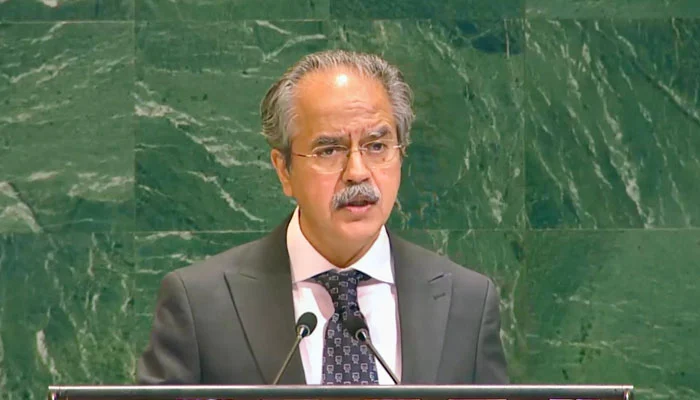
Karachi – The 193-member General Assembly adopted a resolution with 116 votes in favor, 12 abstentions (including India), and 2 against (Israel and the United States), urging the Taliban to uphold human rights, combat terrorism, and ensure Afghanistan does not become a safe haven for terrorist groups like ISIL-K, Al-Qaeda, and TTP.
The resolution also expressed alarm at the Taliban’s continuing repression of Afghan women and girls, urging immediate reversal of policies that exclude them from education, work, and public life.
Pakistan Backs Resolution, Cites Escalating Terror Threat
Pakistan voted in favor of the resolution, aligning with global concerns, but emphasized its own immediate security challenges due to cross-border terrorism.
Ambassador Asim warned that over 6,000 TTP fighters remain active on Afghan soil, posing a direct and persistent threat to Pakistan’s national security.
“Terrorism emanating from Afghanistan is a serious threat to its neighbors, particularly Pakistan,” he said. “With cross recruitment between groups like TTP and ISIL-K, the danger extends beyond our borders and threatens the wider region.”
He revealed that in recent weeks, Pakistani law enforcement agencies have confiscated modern arms and ammunition—traced back to weapons left behind by retreating international forces in Afghanistan—used in sophisticated attacks against Pakistan.
Regional Stability at Stake
Calling for a comprehensive and inclusive engagement strategy, Pakistan welcomed ongoing UN-led initiatives like the Doha Process, and urged the global community to avoid isolation or punitive measures that could worsen the crisis.
“Afghanistan must not be abandoned again,” Ambassador Asim said. “What couldn’t be achieved through war cannot be realized through isolation, sanctions, or financial coercion.”
He stressed that Pakistan has long borne the burden of hosting Afghan refugees, with over a million undocumented Afghans crossing into Pakistan since August 2021. He urged the global community to support the underfunded 2025 Humanitarian Response Plan, of which only 15.7% of the $2.42 billion needed has been secured so far.
Call for Economic Revival and Human Rights
Ambassador Asim also pushed for reviving Afghanistan’s economy and banking system, including unfreezing of financial assets held abroad. He said Pakistan remains committed to regional connectivity through projects like TAPI, CASA-1000, Uzbekistan-Afghanistan-Pakistan railway, and extension of the China-Pakistan Economic Corridor (CPEC) into Afghanistan.
While supporting Afghan sovereignty, Pakistan expressed deep concern over the Taliban’s treatment of women and girls, terming the restrictions “inconsistent with Islamic traditions and international norms.” He highlighted that Pakistan currently supports 4,500 Afghan students, one-third of whom are female.
Preventing Another Collapse
Concluding his remarks, the ambassador stressed the dangers of a return to conflict in Afghanistan.
“There is only one authority in control of Afghanistan. We must avoid igniting another conflict that would destabilize the entire region,” he said. “Spoilers—internal or external—must be prevented from fuelling further instability and violence.”
As Afghanistan teeters on the brink of economic collapse and humanitarian disaster, Pakistan’s message at the UN was clear: only coordinated global engagement—not isolation—can avert another catastrophe.