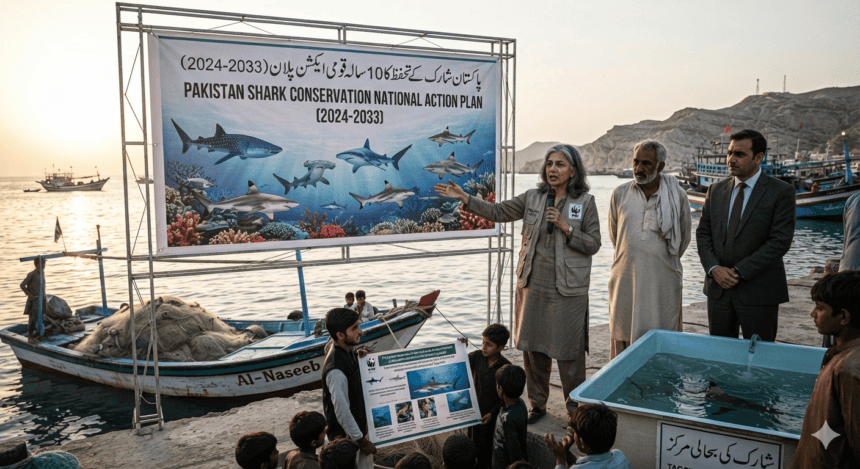
Pakistan has officially launched a 10-year national action plan aimed at reversing the decline of shark and ray populations in its territorial waters. The initiative, spearheaded by the Ministry of Climate Change and Environmental Coordination alongside the World Wide Fund for Nature (WWF-Pakistan), targets the regulation of high-seas fishing and the protection of critical habitats.
For decades, sharks have been accidental victims of Pakistan’s massive gillnet fishery. Data from local marine biologists indicates that thousands of sharks—including endangered species like the scalloped hammerhead and the oceanic whitetip—are caught annually as bycatch. This new strategy shifts the focus from simple observation to mandatory reporting and gear modification for commercial vessels.
The plan mandates the use of circle hooks and specific net depths, changes designed to reduce incidental shark entanglement. It also establishes a strict “no-take” policy for vulnerable species, requiring fishermen to release any protected sharks caught in their nets immediately.
“We aren’t just looking at numbers on a spreadsheet,” said a senior official involved in the policy drafting. “We’re looking at the survival of the entire Arabian Sea ecosystem. If the apex predators disappear, the collapse of our commercial fisheries is inevitable.”
The economic stakes are high. Pakistan’s fishing industry supports millions of livelihoods, but overfishing has already led to a noticeable decline in catch sizes for local communities. The government’s approach relies on a carrot-and-stick model: providing training and equipment subsidies to small-scale fishermen while imposing heavy fines on industrial trawlers that fail to report bycatch.
Critics point to the daunting challenge of maritime enforcement. Patrolling the vast coastline and monitoring thousands of small boats remains a logistical hurdle that previous conservation efforts have failed to clear. The government acknowledges the gap, proposing the use of satellite tracking and community-led monitoring programs to bridge the oversight.
The next two years serve as the pilot phase. During this window, the government will track mortality rates and assess whether the gear modifications actually translate into a measurable rebound in shark populations.
If these measures fail to curb the decline, the ministry has signaled it will move toward more restrictive seasonal bans on specific fishing grounds. The survival of Pakistan’s marine predators now depends on whether the government can force a change in industry habits before the damage becomes irreversible.