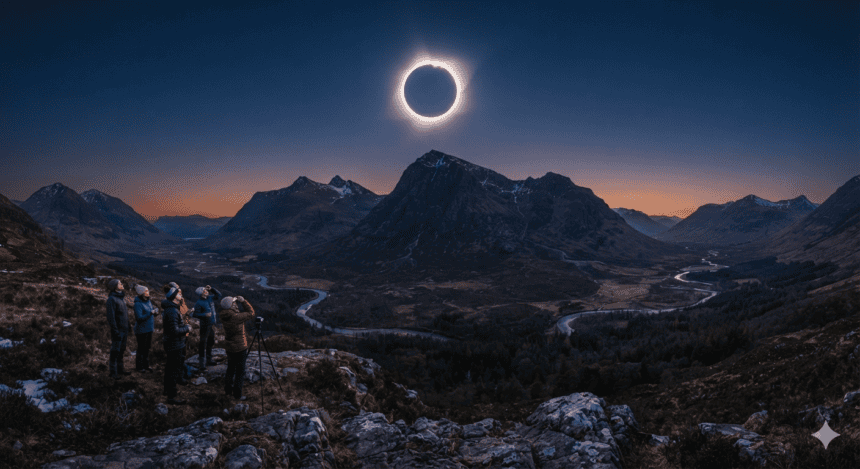
Scotland’s stargazers are in for a brief, albeit limited, spectacle later this month. A partial solar eclipse will track across the North Atlantic, with the northernmost parts of Scotland positioned to catch a glimpse of the moon taking a small bite out of the sun.
The event occurs on March 29. For those in the Outer Hebrides, Orkney, and Shetland, the moon will begin its transit across the solar disc shortly after sunrise.
Don’t expect a sudden drop in temperatures or the midday darkness associated with a total eclipse. This is a marginal event. In Stornoway, the eclipse will reach its peak at roughly 10:30 a.m., with only about 5% to 8% of the sun obscured. Further south in Glasgow and Edinburgh, the eclipse will be virtually invisible, as the moon’s path misses the bulk of the Scottish mainland entirely.
The astronomical mechanics are straightforward: the moon passes between the Earth and the sun, casting a shadow that primarily falls across the Arctic and parts of Greenland. Scotland sits on the very southern edge of this shadow’s reach.
“It’s a minor alignment,” said one local observatory spokesperson. “Unless you have specialized solar filters and a clear eastern horizon, you’ll likely miss the subtle dimming of the light.”
Safety remains the primary concern. Even with a small percentage of the sun covered, looking directly at the solar disc is dangerous. Standard sunglasses offer zero protection. Astronomers are urging the public to use ISO-certified eclipse glasses or indirect viewing methods, such as a pinhole projector, to avoid permanent retinal damage.
Cloud cover is the ultimate wildcard. March weather in the Northern Isles is notoriously temperamental, and the narrow window of the eclipse means even a brief spell of mist will obscure the view.
For those who miss this week’s event, the next significant solar spectacle visible from the UK won’t occur until August 2026. That event will be far more dramatic, with a near-total eclipse predicted for the British Isles.
Until then, the March 29 transit serves as a reminder of the precision required for these celestial mechanics—and how easily a few miles of latitude can turn a major event into a non-starter.