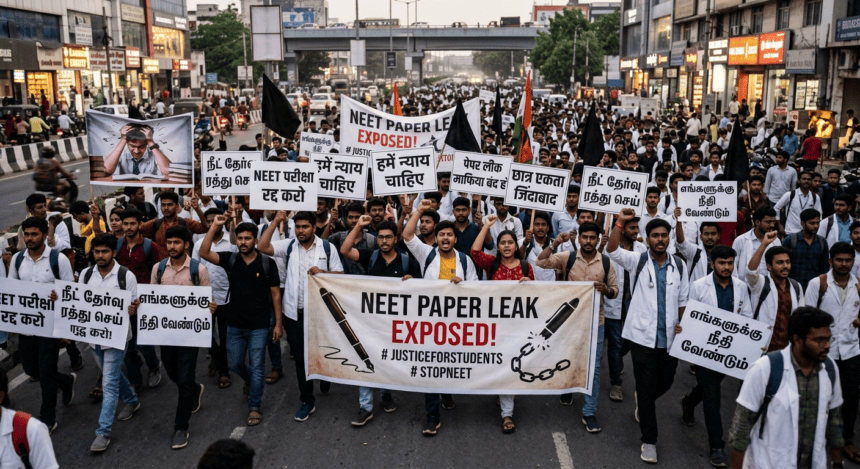
NEW DELHI — The NEET-UG entrance exam, once the golden ticket for aspiring doctors in India, has morphed into a symbol of systemic failure. Following allegations of a massive paper leak and inflated scores, thousands of students have taken to the streets, their anger fueled by a collective sense of betrayal.
For 18-year-old Anjali, the pressure wasn’t just about the competition. It was the crushing realization that her hard work stood no chance against a rigged system. When news of the leak broke, she didn’t just lose a seat; she lost her belief in merit. Two days later, she was found dead in her room. Her parents didn’t mince words: “The fear killed her.”
The protests aren’t just about the 67 students who miraculously scored a perfect 720. They are about the thousands who spent years in cramped study rooms, only to watch the exam’s integrity evaporate. Students in Delhi, Patna, and Kota have been chanting slogans against the National Testing Agency (NTA), demanding a total re-evaluation of the results.
The NTA initially dismissed the claims, calling the irregularities “isolated incidents.” That response only poured gasoline on the fire. When the agency admitted that “grace marks” were awarded to compensate for lost time—a policy that defied its own official guidelines—the credibility gap became a chasm.
“They played with our lives,” said Rahul, a third-time aspirant protesting outside the NTA headquarters. He hasn’t slept in 48 hours. “We aren’t just fighting for a seat anymore. We’re fighting so the next batch doesn’t have to go through this hell.”
The scale of the alleged leak, with police investigations in Bihar uncovering burnt question papers and a web of “fixers” charging millions for leaked keys, suggests a deep-rooted rot. It’s not a glitch in the software; it’s a failure of the entire architecture.
As the Supreme Court weighs petitions to cancel the exam, the government finds itself in a corner. The education ministry has promised a high-level committee to review the NTA’s processes, but for students camping out on sidewalks, promises are cheap.
The uprising has moved beyond the exam halls. It has become a referendum on whether the system can still deliver justice to those who play by the rules. If the government fails to address the rot, the next generation of doctors may not just be disillusioned—they may be gone entirely.