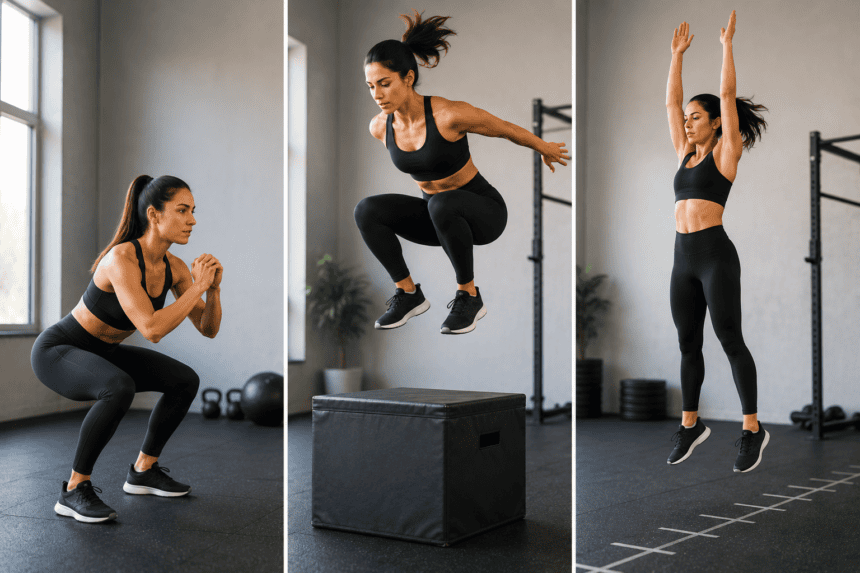
Plyometric exercises are fast, dynamic movements designed to build strength, power, balance and agility. Although many people associate plyometrics with advanced box jumps and hurdle jumps, beginners can start with simpler movements that require little or no equipment.
What Are Plyometrics?
Plyometric training uses short, intense bursts of movement that activate fast-twitch muscle fibers, particularly in the lower body. These muscles help generate explosive power, which can improve speed and jumping ability.
Plyometric exercises are especially useful for athletes involved in sports such as basketball, volleyball, tennis and track and field. They can also provide a challenging cardiovascular workout while improving coordination and agility.
Can Beginners Do Plyometric Exercises?
Yes, but beginners should start slowly. Advanced exercises such as jumping onto high boxes or over hurdles can place considerable stress on the body and are better attempted with proper training and supervision.
People with previous knee, hip or back problems, or those who have difficulty with balance, should consult a doctor before starting plyometric training.
1. Side Jumps
Side jumps are a simple way to introduce lateral movement and jumping into a workout.
Stand upright with your feet together. Shift your weight onto one foot and jump sideways, landing on the opposite foot. Bring the other foot alongside it, then repeat the movement in the opposite direction.
Beginners can make the exercise easier by jumping a shorter distance and staying close to the floor. Harvard Health suggests five to 15 repetitions per set, with one to three sets and rest between sets.
2. Jump Rope
Jumping rope is another beginner-friendly plyometric exercise. It involves repeated, quick jumps and requires coordination while keeping ground contact short.
Start with about two minutes of jumping. If that feels too difficult, divide the workout into 10- to 30-second intervals and gradually increase the duration.
If you do not have a rope, you can practice the same jumping motion without one.
3. Forward Hops
Forward hops work on explosive movement while challenging balance and coordination.
Stand with your feet together, bend your knees and jump forward about one to two feet. Turn around and jump back to your starting position.
Beginners can use shorter jumps and remain closer to the ground. As the exercise becomes easier, the distance or height can gradually be increased. Harvard Health recommends five to 10 hops per set, with one to three sets and rest between them.
How to Exercise Safely
Because plyometrics involve jumping and landing, proper technique is important.
- Exercise on a surface that provides some cushioning, such as grass or a well-padded floor.
- Avoid jumping on concrete, asphalt or tile.
- Start with small jumps rather than trying to jump as high as possible.
- Bend your knees when landing instead of locking them.
- Try to land softly and evenly.
- Increase the difficulty gradually as your strength and coordination improve.
The Bottom Line
Plyometrics don’t have to be complicated or reserved for athletes. Beginners can start with side jumps, jump rope and forward hops to develop power, coordination and agility. Starting with small, controlled movements and using a suitable surface can help reduce unnecessary impact while allowing the body to gradually adapt to explosive exercise.