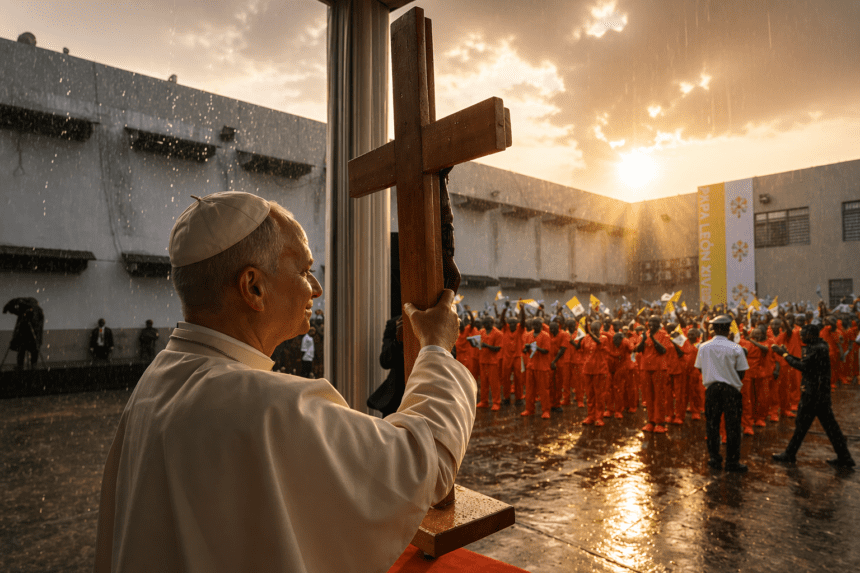
Pope Leo XIV used one of the most symbolically charged moments of his Africa trip to step inside Bata Prison in Equatorial Guinea on Wednesday, April 22, telling inmates they were not forgotten and urging the country to build a justice system that protects human dignity rather than simply punishes. The prison stop was part of the pope’s final full day in Equatorial Guinea, the last leg of his 13–23 April visit to Algeria, Cameroon, Angola and Equatorial Guinea.
The visit itself was brief on paper but heavy with meaning. According to the Vatican program, Leo traveled from Malabo to Mongomo for morning Mass, then flew onward to Bata, where the prison visit was scheduled for 4:50 p.m. local time before later events at a memorial for the victims of the March 7, 2021 explosions and a gathering with young people and families at Bata Stadium.
What made the prison appearance stand out was the setting as much as the message. AP reported that Leo told prisoners, “you are not alone,” and tied that pastoral appeal to a broader call for freedom, justice and a social order with more room for human dignity. In the same day’s preaching, he urged citizens to serve “the common good rather than private interests” and to narrow the gap between the privileged and the disadvantaged.
That language mattered because Leo was speaking in one of Africa’s most tightly controlled states. Equatorial Guinea is led by President Teodoro Obiang Nguema Mbasogo, who has ruled since 1979. Rights groups and exile voices have long accused the government of repression, arbitrary detention and using the country’s oil wealth to enrich a small elite, while much of the population remains poor. AP’s reporting from the visit said the pope’s presence has stirred anxiety among some exiles, who fear it could be used to soften the international image of an entrenched authoritarian system.
Leo did not directly confront Obiang by name during this stage of the trip. That was noticeable. Still, he did not exactly speak in vague pleasantries either. On arriving in Equatorial Guinea, he criticized the exploitation of Africa’s resources and pointed to inequality and corruption-linked realities that hover over the country’s public life. By the time he reached Bata Prison, the message had sharpened into something more personal: justice, yes, but justice with a human face.
The political sensitivity around the stop was obvious even before Leo landed. AP reported that Equatorial Guinea’s justice minister, Reginaldo Biyogo Ndong, denied that the country abuses human rights and said the prison and justice systems respect international standards. At the same time, Vatican officials defended engagement in difficult political environments, arguing that the Church’s role is not to “go to war against the government,” but neither to accept injustice as normal.
For the Catholic Church in Equatorial Guinea, the pope’s visit was historic in its own right. Vatican and AP reporting note that this was the first papal visit to the country since John Paul II’s trip in 1982, and local Catholics had openly spoken of waiting decades for such a moment. That explains some of the warmth on the streets. But it also explains why the prison stop landed so hard: in a country where public symbolism is rarely neutral, choosing prisoners as one of the pope’s final encounters sent its own message.
In the end, Leo’s stop at Bata Prison did not produce a thunderous political denunciation. It did something subtler, maybe more difficult to dismiss. By standing before inmates in a country dogged by allegations of abuse, and by insisting on dignity, freedom and the common good, the pope placed moral pressure on the system without turning the moment into open diplomatic rupture. In Equatorial Guinea, that alone is news.