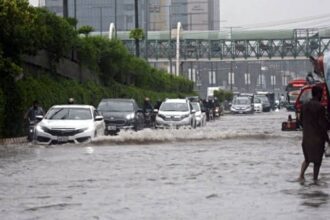

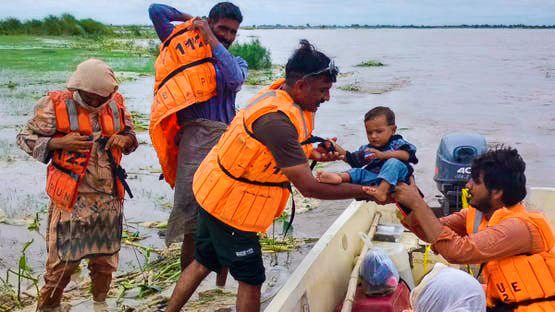
LAHORE: At least 25 people have lost their lives in Punjab as raging riverine floods, fueled by unusually heavy monsoon rains and upstream water release from India, swept through the province, submerging villages and forcing thousands to flee their homes.
Among the victims were five members of one family in Sambarial, Sialkot district. In Gujranwala division, 15 people died, while four lives were lost in Gujrat, three in Narowal, and two in Hafizabad, according to officials.
The floods have caused widespread destruction, drowning hundreds of villages in Kasur, Narowal, Pindi Bhattian, Bahawalnagar, and Chiniot, leaving tens of thousands homeless. Floodwaters washed away cattle, houses, and thousands of acres of standing crops, pushing already struggling farming communities into crisis. In Bahawalnagar alone, over 105 villages have been inundated, displacing nearly 90,000 people and affecting a total of 150,000 residents.
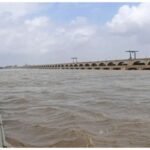
The Chenab River is witnessing extremely high flood levels, with flows recorded at 996,000 cusecs at Qadirabad and 859,000 cusecs at Khanki Barrage. At Head Marala, the flow is around 191,000 cusecs, prompting warnings for surrounding areas to remain on high alert. Meanwhile, floodwater has already entered villages in Chiniot and Wazirabad.
In River Ravi, the water level at Shahdara in Lahore reached 145,000 cusecs, while at Jassar it surged to 152,000 cusecs. Officials, however, assured that the peak flow has passed and the water level is expected to gradually recede, keeping Lahore safe for now.
The Sutlej River is also in high flood, with flows of 261,000 cusecs at Ganda Singh Wala and 109,000 cusecs at Head Sulemanki. In Chishtian, six protective embankments collapsed, flooding over 300 villages and destroying crops spread across 7,000 acres.
Local farmers in some areas attempted to build an eight-kilometre-long protective dyke to save their homes, but officials warn that if it gives way, up to 20,000 houses could be washed away.
Authorities are struggling to manage the disaster as rescue efforts continue, but thousands remain stranded with dilapidated dykes failing and villages cut off by rising waters.