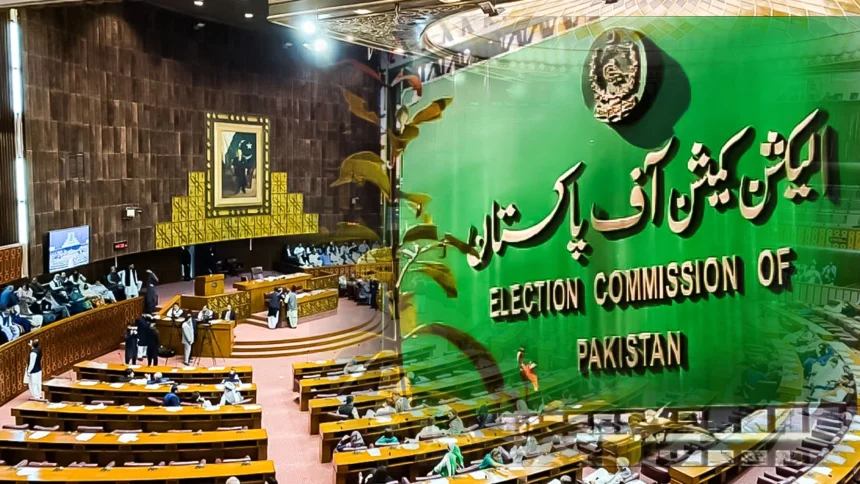
ISLAMABAD – The ruling coalition has achieved a two-thirds majority in the National Assembly following the Election Commission of Pakistan’s (ECP) official distribution of reserved seats on Wednesday. This step was taken in compliance with the recent Supreme Court verdict, which denied the Pakistan Tehreek-e-Insaf (PTI) eligibility for reserved seats.
The ECP awarded 13 reserved seats in the National Assembly to the Pakistan Muslim League-Nawaz (PML-N), 4 to the Pakistan Peoples Party (PPP), and 2 to the opposition Jamiat Ulema-i-Islam-Fazl (JUI-F).
This reshuffling followed the Constitutional Bench’s landmark ruling, which overturned an earlier Supreme Court judgment from July 2024 that had granted PTI entitlement to reserved seats for women and minorities. The latest verdict declared PTI ineligible as a parliamentary party, effectively removing its right to reserved representation.
Acting swiftly, the ECP rescinded its previous notifications from July 2024 that had declared PTI-backed independents as returned candidates under the party’s banner in the National and provincial assemblies. The Commission subsequently issued new notifications allocating reserved seats to parties in accordance with the updated judgment.
Two-Thirds Majority Achieved
With the latest allocation, the ruling alliance now commands 235 out of 336 seats in the National Assembly — comfortably surpassing the 224-seat threshold required for a two-thirds majority. According to the updated composition released by the NA Secretariat, the opposition now holds 98 seats, with one MNA suspended and two reserved seats remaining vacant.
Reserved Seats Across Provinces
The ECP also reallocated reserved seats in the provincial assemblies:
-
Khyber Pakhtunkhwa (KP): JUI-F received 10 seats, PML-N 7, PPP 6, while PTI-Parliamentarians and ANP received 1 seat each.
-
Punjab Assembly: PML-N received 23 seats, PPP 2, PML-Q and Istehkam-e-Pakistan Party got 1 each.
-
Sindh Assembly: PPP gained 2 seats, MQM-Pakistan 1.
Legal Background of the Case
This redistribution follows the controversial verdict of the Peshawar High Court (PHC) on March 25, 2024, which had denied the Sunni Ittehad Council — joined by PTI-backed independents post-election — eligibility for reserved seats.
Initially, Justices Ayesha A. Malik and Aqeel Ahmed Abbasi had rejected the review petitions submitted by the PML-N, PPP, and the ECP. However, they were later excluded from the final Constitutional Bench.
Justice Jamal Khan Mandokhail dissented, maintaining that PTI should retain 39 seats and should be considered a parliamentary party, but his position was not adopted in the majority ruling.
In response to the Supreme Court’s final judgment, the ECP was instructed to reassess the affiliations of 80 returned candidates within 15 days and allocate the reserved seats accordingly — a process which now appears complete.