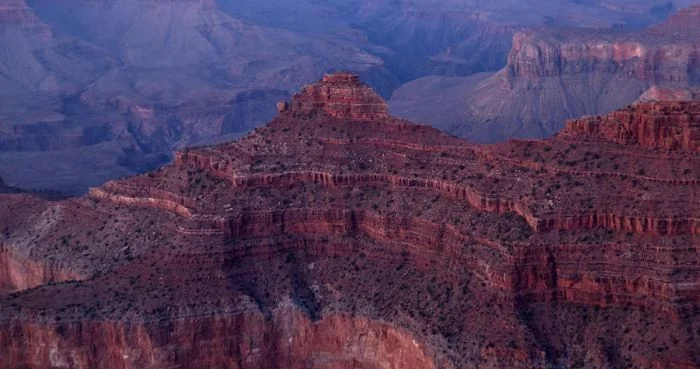
A new study has added a major piece to one of American geology’s oldest puzzles, arguing that the Grand Canyon’s modern course took shape after an ancient lake in northern Arizona gradually filled and spilt westward, helping the Colorado River carve the canyon. The research, published on April 16 in Science, supports the long-debated “lake spillover” idea and places the ancestral Colorado River in the Bidahochi Basin about 6.6 million years ago.
The key evidence came from zircon crystals locked inside sandstone samples collected in the Bidahochi Basin, just east of the Grand Canyon. Researchers compared the zircons’ ages and chemical signatures with those from known early Colorado River sediments and found a close match, suggesting the basin was receiving Colorado River sediment millions of years before the river fully linked up with its present route.
According to the study’s interpretation, that river-fed basin became a large lake, often referred to as Lake Bidahochi or Hopi Lake. Over time, water levels rose high enough to cross the Kaibab Arch, allowing water to move west and helping establish the river path that would become the Grand Canyon. The researchers say other processes may have helped, but they argue spillover was the main trigger.
The finding matters because it helps close a long-standing timeline gap. Scientists have generally agreed the Colorado River existed in western Colorado around 11 million years ago and was exiting the Grand Canyon region by roughly 5.6 million years ago, but the route it took in between has remained heavily disputed. This new work offers a concrete answer for part of that missing chapter.
Still, the debate is not over. Some geologists say the new evidence makes a strong case that spillover was important, but others remain unconvinced that such a large lake existed in the way the authors propose. Critics cited in current coverage argue that older topography and earlier river pathways may have allowed water to flow through the region without the kind of giant lake the paper envisions.
So this is not quite a final verdict, even if the headline sounds dramatic. What the study does seem to do is narrow the argument. Researchers on different sides are increasingly converging on parts of the timeline and on the idea that the canyon formed in stages, even as they continue to disagree over exactly how the breakthrough happened.
In other words, scientists may not have “solved” the Grand Canyon in one stroke, but they have pushed the story forward in a meaningful way. And for a landscape that draws more than four million visitors a year and still keeps some of its deepest secrets, that is big news.