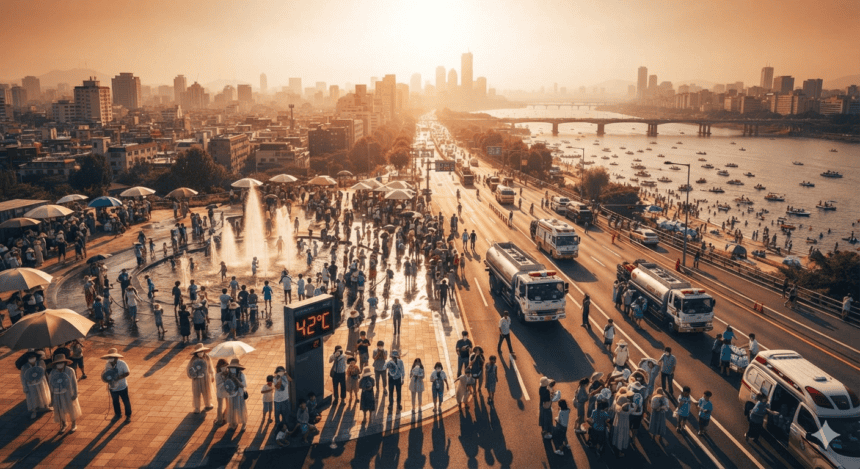
Seoul’s residents didn’t get a break from the heat last night. The Korea Meteorological Administration confirmed today that the capital recorded its highest minimum temperature since record-keeping began in 1907, with the mercury refusing to dip below 30.3 degrees Celsius (86.5 degrees Fahrenheit).
This marks the 11th consecutive “tropical night” for the capital—a phenomenon where temperatures stay above 25 degrees Celsius until dawn. For Seoul, this is the longest streak of such nights since 2018. The stifling humidity, trapped by a high-pressure system, has turned the city into a pressure cooker, forcing the government to issue its highest level of heatwave alerts.
The heat isn’t just an inconvenience; it’s a public health crisis. Emergency rooms across the country report a sharp uptick in heat-related illnesses, ranging from heatstroke to severe exhaustion. The Ministry of the Interior and Safety confirmed that electricity consumption hit an all-time peak this week as millions cranked up air conditioning units to survive the relentless humidity.
“The air is thick,” said Kim Ji-soo, a delivery driver in Seoul’s Gangnam district. “Even at 3:00 AM, it feels like walking into a sauna. You finish your shift, but your body never cools down.”
This heatwave is part of a broader, global pattern of extreme weather. From Europe’s scorched Mediterranean coast to record-breaking temperatures across parts of North America and Asia, the data aligns with climate scientists’ long-standing warnings about rising global baselines. The Korean Peninsula is warming faster than the global average, a trend that experts say is increasingly difficult to mitigate with current infrastructure.
While the government has urged citizens to limit outdoor activity and stay hydrated, the meteorological agency offers little immediate relief. Forecasts suggest the high-pressure dome remains locked over the region for at least another week.
For the residents of Seoul, the promise of a cool breeze remains out of reach. The forecast for the coming days shows no significant drop in temperature, leaving the city to brace for what could be its most grueling summer on record.