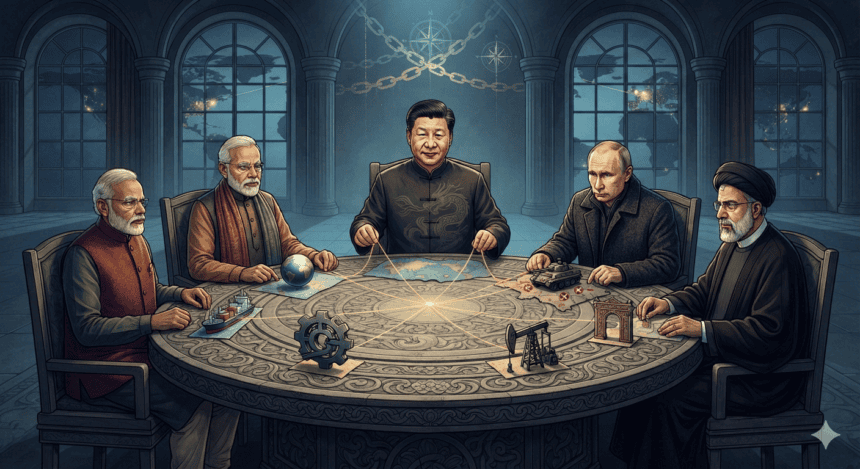
BEIJING — President Xi Jinping is quietly reshaping the global map, using a series of high-level meetings with Russian, Indian, and Iranian leadership to cement China’s position as the indispensable broker of the Global South. While Washington remains focused on the mechanics of containment, Beijing is busy building a parallel infrastructure of trade and security that effectively neutralizes the impact of Western-led economic pressure.
The strategy is simple: turn the isolation of partners into China’s own strategic depth. By positioning Beijing as the primary market for Russian energy, the main diplomatic mediator for Iran, and a critical, if complicated, trade partner for India, Xi has created a diplomatic buffer that makes broad-based Western sanctions increasingly difficult to enforce.
This isn’t about traditional alliances. It’s about leveraging the “leverage wars.”
When Xi meets with Vladimir Putin, the focus isn’t just on the conflict in Ukraine; it’s on the structural integration of the Russian economy into China’s domestic supply chains. Beijing isn’t just buying discounted oil—it’s ensuring that the Russian financial system operates within a Chinese-led payments architecture, insulating it from the reach of the U.S. dollar.
For Tehran, China provides the economic oxygen that keeps the regime afloat despite years of stringent Western measures. By formalizing long-term trade agreements, Xi has essentially signaled to the West that Iran’s economic survival is now tethered to Chinese stability. It’s a high-stakes gamble that forces Washington to choose between aggressive secondary sanctions—which would alienate Beijing—or accepting a status quo that keeps Tehran within China’s orbit.
The inclusion of India in this diplomatic calculus is the most delicate piece of the puzzle. Despite the persistent border tensions in the Himalayas, New Delhi’s participation in these summits signals a pragmatic realization: India cannot afford to be sidelined as the world’s power centers realign. Xi recognizes this friction and exploits it by offering India a seat at the table of the Global South, forcing New Delhi to balance its strategic partnership with the West against the reality of its regional geography.
These summits offer Xi a unique brand of soft power. He isn’t asking these nations to adopt Chinese values; he’s offering them a way to circumvent the Western-dominated global order. It’s an attractive pitch for leaders who feel their sovereignty is threatened by the unpredictable nature of Western domestic politics.
The results are already visible. From the expansion of the BRICS bloc to the stabilization of volatile energy prices through non-dollar transactions, the “Xi doctrine” is gaining traction. It suggests that while the West focuses on military deterrence, Beijing is winning the long game by rewriting the rules of economic engagement.
The U.S. and its allies are now left with a shrinking window to respond. As these regional powers align their interests with Beijing, the cost of decoupling from China grows higher, and the influence of Western-led institutions like the G7 begins to look increasingly like a relic of a different era.
Xi has moved the goalposts. He’s no longer playing the game of global integration; he’s building a new field entirely.