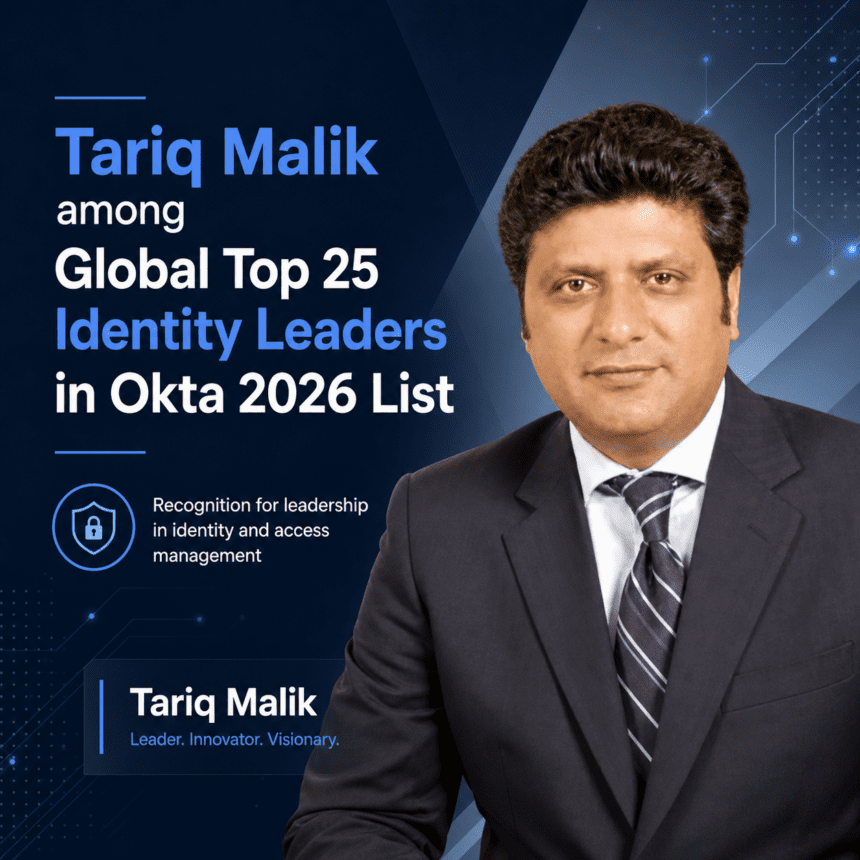
Tariq Malik, the former chairman of Pakistan’s National Database and Registration Authority (NADRA) and a current technical adviser on digital public infrastructure at the World Bank, has been named to Okta’s latest Identity 25 list, a global recognition program for figures working in digital identity, trust and security. Okta’s official Identity 25 page says the 2026 edition honors people shaping identity through technology, standards, policy and implementation.
For Pakistan, it’s one of those recognitions that lands beyond the usual corporate award cycle. Malik’s inclusion puts a Pakistani technocrat in a conversation usually dominated by standards architects, authentication specialists, public-sector identity builders and cybersecurity leaders from major international institutions and companies. Pakistani media reports said the formal public display tied to the selection was scheduled for May 4 in New York’s Times Square.
Okta describes the Identity 25 as an annual effort to spotlight what it calls the “often unsung stars” of the identity space. The company says the list spans software, standards, academic work and strategic execution, reflecting how central identity has become as governments and businesses deal with fraud, privacy, access control and digital service delivery at scale.
That broader context matters in Malik’s case. He is closely associated with Pakistan’s digital identity architecture through his work at NADRA, and recent coverage of the recognition links the honor to his role in identity systems, digital public infrastructure and governance-focused reform. The News identified him as a World Bank technical adviser and former NADRA chief, while Pakistani technology outlets framed the recognition around his contribution to public-sector identity transformation.
There is, though, a small wrinkle in the source trail. Okta’s webpage clearly presents the current report as the 2026 edition, but the downloadable PDF available through that page appears to contain internal page labels referring to “The 2025 Identity 25.” That looks like a labeling or production inconsistency rather than evidence against the recognition itself, because the live Okta page is explicitly branded as the 2026 edition.
Malik has long argued that digital identity is not just about databases or cards; it’s really about trust in public systems. In comments reported by The News, he linked his international work and his departure from Pakistan’s domestic institutional space to a push for more transparent, technology-backed governance, including cleaner electoral processes and stronger public confidence in state systems. That makes this recognition feel a bit bigger than a personal milestone. It also revives a familiar debate in Pakistan: whether the country will fully use the technical capacity it has already built in identity and public data systems.
At a time when identity has become a frontline issue, not a back-office one, that debate isn’t academic. Governments are under pressure to expand access to services while protecting citizens from fraud, exclusion and surveillance abuses. Okta’s framing of this year’s list leans heavily into that tension, saying the people it honors are helping keep digital transactions secure, privacy better protected and public access more effective. That is exactly the terrain on which Malik’s work has usually been judged, by supporters and critics alike.
For now, the headline is straightforward: a Pakistani official with a long track record in digital identity has been recognized on a prominent global list. The harder question, and probably the more important one, is what Pakistan does with that legacy next.