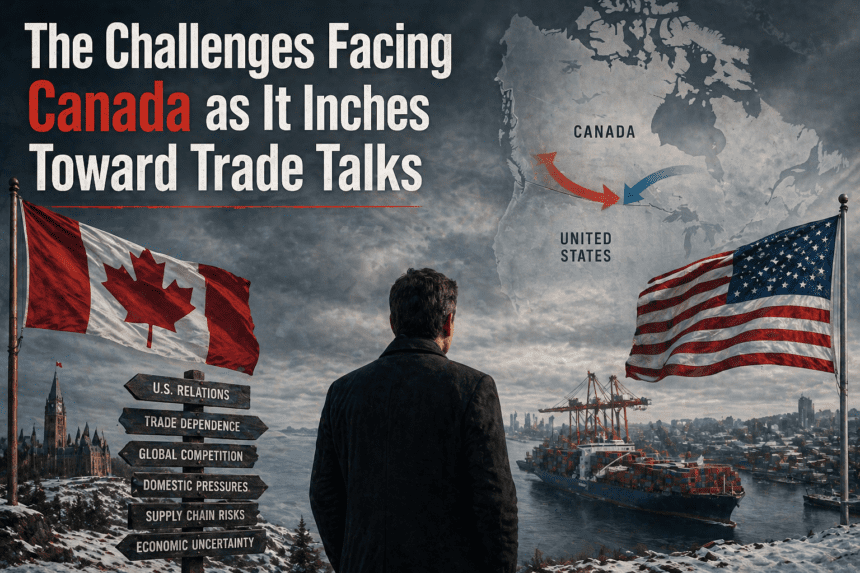
Canada is moving, cautiously, toward a new round of trade talks with the United States. But even as the door cracks open, the list of obstacles is long, politically sensitive, and getting harder to manage. At the center of the tension is a simple reality: Ottawa wants a serious negotiation, while Washington appears to be signaling that any real progress may come only after Canada makes concessions first.
Prime Minister Mark Carney has made clear that Canada does not accept the idea that the United States can dictate the terms of a future agreement or the upcoming review of the United States-Mexico-Canada Agreement, expected in July. That public stance matters, because it reflects a broader Canadian concern that these talks may begin on uneven ground, with tariff pressure and political leverage already being used as bargaining tools.
One of the biggest challenges is tariffs. Any meaningful negotiation is likely to run straight into disputes over U.S. duties on key Canadian sectors, especially autos, steel and aluminum. Those industries are not side issues for Canada; they sit near the heart of its export economy, and they carry political weight far beyond trade statistics because of the jobs tied to them.
Then there is the deeper structural problem: Canada’s dependence on the U.S. market. Carney said this week that what was once seen as an economic strength has become a weakness that must be corrected. That is a striking admission from a Canadian leader, and it gets to the core dilemma. Canada needs access to the American market, yet that dependence also leaves it exposed whenever Washington shifts toward protectionism or unilateral pressure.
Another likely flashpoint is supply management, especially in dairy, poultry and eggs. The U.S. has long criticized Canada’s protections in these sectors, and Carney has already signaled that Ottawa intends to defend them. That makes the politics tricky. These protections are deeply sensitive inside Canada, particularly in provinces where farmers see them as essential, but they are also the sort of issue American negotiators regularly target.
There is also a broader strategic tension running underneath the talks. Canada says it wants to diversify trade, attract new investment, reduce internal trade barriers between provinces and rely less on the U.S. economy over time. That is sensible on paper. In practice, though, diversification is slow, and no other partner can replace the U.S. market quickly. So Ottawa is trying to do two things at once: prepare for a less reliable America while still negotiating with the same America from a position of vulnerability.
And the mood itself is a challenge. This is not a normal trade climate. Recent friction has included public criticism from senior U.S. officials, arguments over “Buy Canadian” policies, complaints about market access, and broader frustration over how closely Canada should align with Washington on trade and industrial policy. Even where communication has resumed, trust does not appear to have fully returned.
That leaves Canada in a familiar but uncomfortable spot: close enough to talks to suggest diplomacy is still possible, but far enough from certainty that every major issue remains contested. Tariffs, market access, domestic protections and economic dependence are all still on the table. So yes, Canada may be inching toward trade talks. The harder part will be entering them without giving away too much before they even properly begin.