

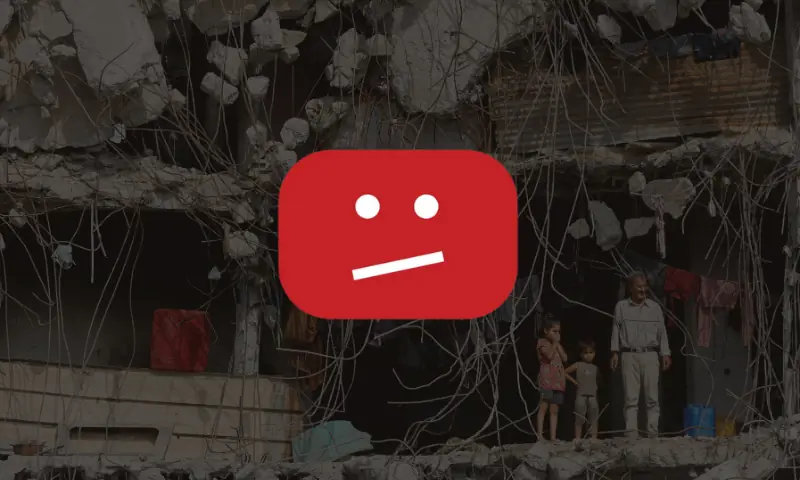
Video-sharing platform YouTube recently removed hundreds of videos uploaded by Palestinian human rights groups that documented alleged Israeli war crimes in Gaza . The move has raised serious concerns among human rights activists and digital freedom experts, who are calling it an “attempt to cover up the truth.”
According to a report by the American magazine The Intercept , YouTube has closed the YouTube channels of three major Palestinian human rights organizations — Al-Haq , Al-Mizan Center for Human Rights , and the Palestinian Center for Human Rights (PCHR) — by deleting more than 700 videos.
These organizations had been collecting visual evidence of civilian casualties, destroyed hospitals, and affected neighborhoods through these videos for years, which they consider key evidence for global justice.
“These are not just videos, they are evidence,” a spokesman for al-Haq said. “By deleting them, YouTube has actually played a role in erasing the truth.”
YouTube’s position: "This was a legal requirement”
YouTube, which is owned by Google, confirmed the move but said it was not political censorship but legal compliance . The company argued that there was a legal impediment to providing the service to certain organizations and regions under US sanctions laws.
However, critics say this justification is illogical, as the deleted videos did not show violence or hatred, but rather the effects of war operations .
“When platforms delete human rights documents, they’re not just erasing videos — they’re eliminating potential evidence of justice,” says digital rights expert Marwa Fatifa .
“Censorship in the name of legal compliance”
Human rights activists and journalists around the world are accusing YouTube of suppressing Palestinian voices . “This move deprives Palestinians of their right to preserve their own history and communicate their truth to the world,”
the Palestinian Center for Human Rights (PCHR) said in a statement.
Over the past year, other social media platforms — such as Meta (Facebook, Instagram) — have faced similar accusations that they delete Palestinian content for “policy violations.”
Impact on global justice
At a time when investigations into alleged war crimes in Gaza are ongoing, the deletion of these videos could affect the process of global justice.
“Digital platforms have now become part of the battlefield — not with weapons, but in the war of information,” said one independent researcher. “Erasing such evidence is like destroying a crime scene.”
YouTube has not clarified whether the deleted videos have been preserved for legal or research purposes or have been permanently deleted. This lack of transparency has further raised concerns.
A recurring issue
This is not the first time YouTube has faced criticism for removing human rights content. It has previously removed thousands of videos related to conflicts in Syria, Yemen and Myanmar that could have later become evidence in international courts.
The real question is:
When global digital platforms themselves become the custodians of “record keeping,” who remains in control of history?
Experts say that if platforms continue to prioritize “legal compliance” over “context,” they reinforce the narratives of powerful states and erase the voices of victims.
As one Palestinian activist said:
“When Silicon Valley decides what the world should see, justice becomes an option, not a right.”