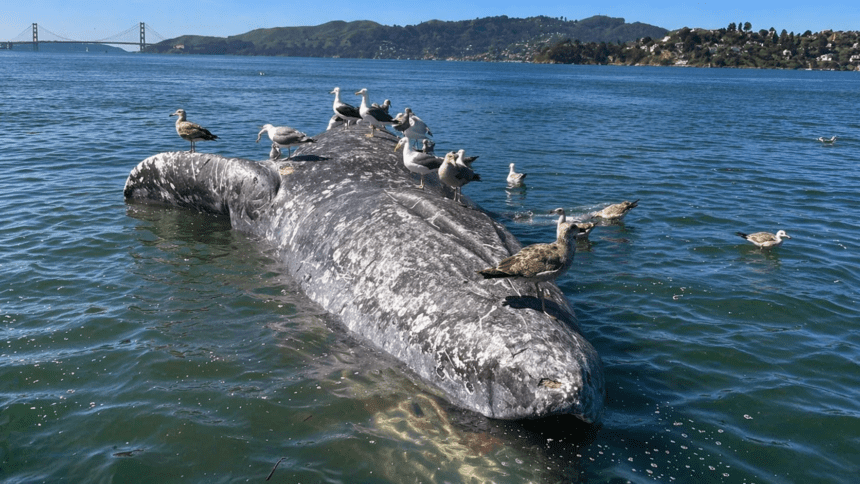
Scientists in California are trying to understand a troubling pattern: more gray whales are entering San Francisco Bay, and too many of them are not making it back out. New research and recent whale deaths in the Bay Area suggest the problem is not one single cause, but a dangerous mix of ship strikes, food stress, and shifting whale behavior as ocean conditions change.
A study highlighted this month found that at least 18% of the gray whales documented entering San Francisco Bay between 2018 and 2025 later died there. Researchers say that figure may even be an underestimate, because not every dead whale is found or examined. The work points to vessel collisions as a major factor, with more than 40% of examined deaths in the area linked to blunt-force trauma consistent with ship strikes.
The geography of the Bay helps explain why the risk is so high. To enter or leave San Francisco Bay, whales must pass through the Golden Gate Strait, a narrow bottleneck crowded with large commercial ships and other vessel traffic. Researchers say fog, busy shipping lanes, and the whales’ low profile in the water make collisions more likely.
But scientists do not think ship strikes are the whole story. A growing body of evidence suggests many gray whales are arriving in poor condition, likely because warming in Arctic feeding grounds is disrupting the prey they depend on. Last year, federal researchers reported that the eastern North Pacific gray whale population continued to decline after the 2019–2023 Unusual Mortality Event, with the winter 2025 estimate at about 13,000 whales, the lowest since the 1970s.
That decline matters because it may help explain why whales are entering San Francisco Bay more often in the first place. Scientists suspect some are breaking from long-established migration patterns and moving into the Bay to look for food, even though it exposes them to heavy maritime traffic and other urban hazards. In other words, the Bay may be acting as both a refuge and a trap.
Recent local counts have added urgency to the concern. The California Academy of Sciences said in 2025 that 24 whales died in the wider San Francisco Bay Area region that year, including 21 gray whales, and that eight of those gray whale deaths were confirmed as suspect or probable vessel strikes. This year, additional gray whale carcasses have again turned up in Bay waters, keeping the issue firmly in public view.
Researchers are now using photo-identification, carcass examinations, sighting records, and monitoring programs to work out exactly why some whales linger in the Bay and why the death toll is so high. Some scientists think injured whales may remain in local waters longer after being struck, while others may be arriving already weakened by malnutrition. Both possibilities are under active study.
The search for answers is also feeding into a push for practical protections. Scientists and conservation groups are backing slower vessel speeds, route adjustments, stronger outreach to ship operators, and better real-time whale detection. Researchers say those measures could reduce collisions, even if they do not solve the larger climate and food-supply pressures driving whales into risky waters.
For now, the picture is becoming clearer, even if it is not complete. Gray whales in San Francisco’s waters appear to be caught between a changing ocean and a hazardous coastal corridor. Scientists are still searching for all the clues, but the early answer looks grim: hungry whales are venturing into the Bay more often, and too many are dying once they get there.