
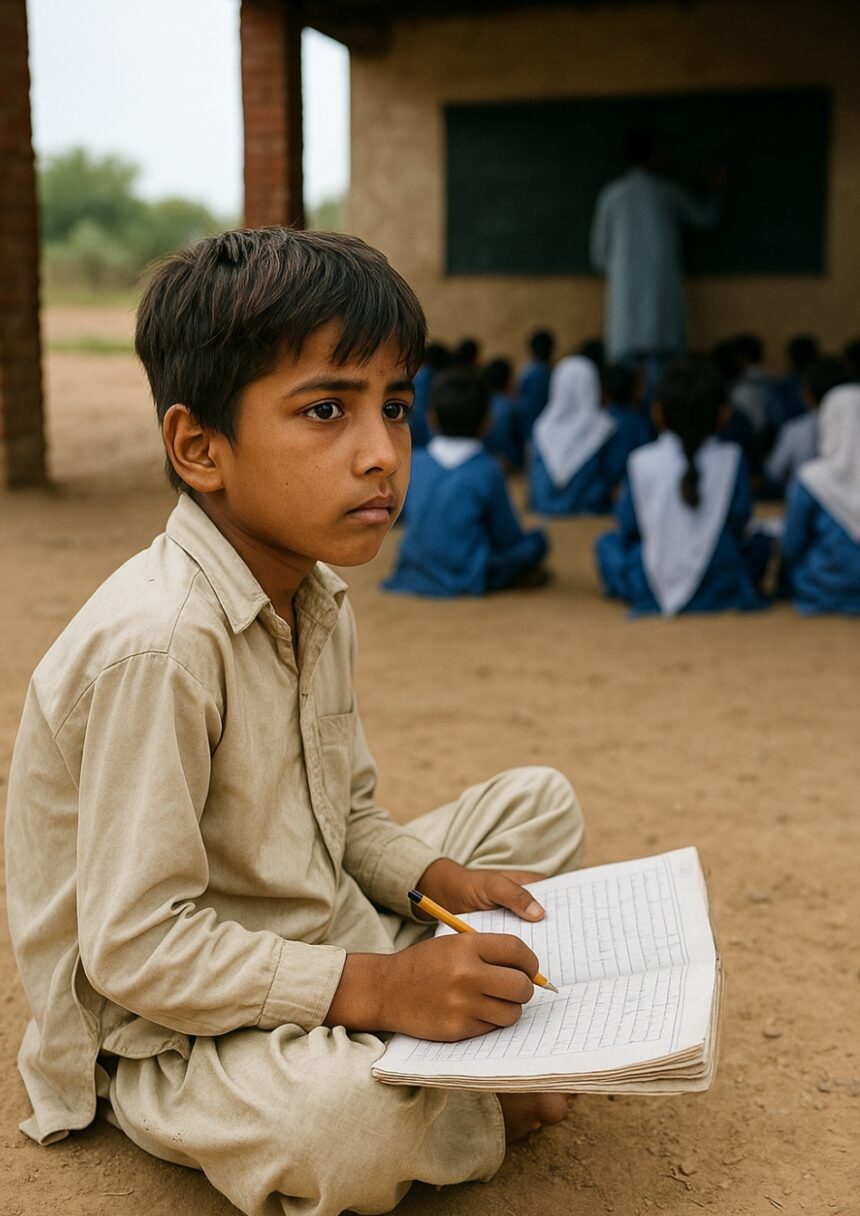
ISLAMABAD: Pakistan’s education sector faces a severe crisis, with nearly 26 million children out of school and only five percent receiving quality education, according to the National Education Policy Development Framework launched on Monday.
The report, unveiled by Federal Education Minister Dr. Khalid Maqbool Siddiqui, revealed that just 12 per cent of the eligible age group currently has access to higher education. The minister warned that unless urgent reforms are implemented, Pakistan’s youth risk being left behind in a rapidly advancing global economy driven by artificial intelligence, science, and technology.
The framework also highlighted alarming challenges beyond access and quality, including 40 per cent child stunting by age five, the persistence of corporal punishment, and the neglect of issues like bullying and child abuse.
Despite a rapid expansion in the higher education sector, the report said Pakistani universities continue to struggle with outdated curricula, weak research standards, and poor alignment with market needs. “Our universities must produce graduates equipped with skills for modern industries,” the document stressed, calling for major investment in STEM fields, innovation, and research facilities.
Pakistan currently ranks 164th out of 193 countries on the Human Development Index, with a literacy rate of just 62 per cent. Experts at the launch noted that while policies have been drafted since 1951, weak implementation and poor governance have stalled progress.
Dr. Siddiqui linked Pakistan’s entrenched poverty to its feudal system, lamenting past failures such as the “feudalisation” of education in 1972. He urged provinces to swiftly adopt the new framework to end decades of stagnation.
The Pakistan Institute of Education (PIE), which prepared the framework in consultation with provincial representatives, said the document would serve as a guiding principle for provincial education policies, with the federal capital expected to draft its own within three months.
Provincial education leaders, including Balochistan’s Education Minister Rahila Durrani, called for nationwide collaboration to tackle challenges such as teacher shortages and inadequate school facilities.