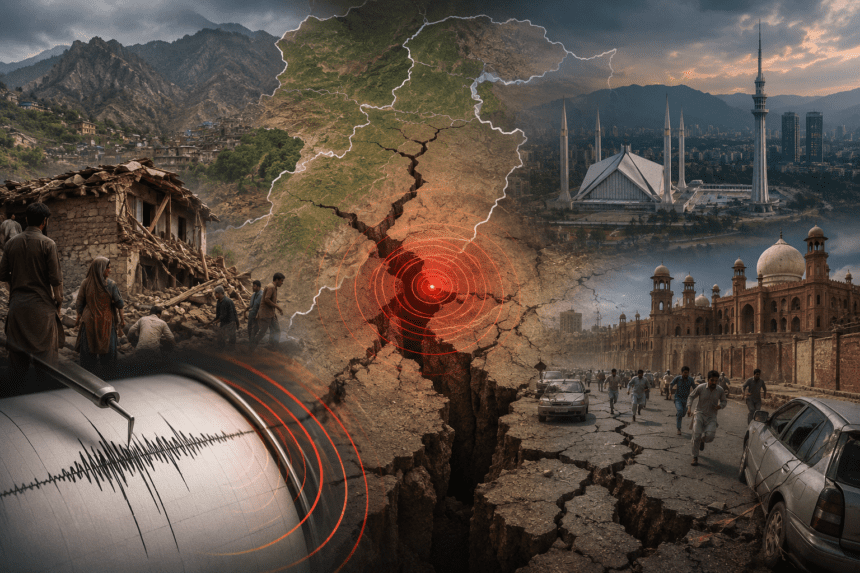
A 5.4-magnitude earthquake rattled parts of Khyber Pakhtunkhwa, Islamabad, and northern Punjab early this morning, sending residents scrambling into the streets.
The tremor struck at 8:42 a.m. local time, with the epicenter traced to the Hindu Kush mountain range in Afghanistan, according to the National Seismic Monitoring Centre. Seismologists recorded the depth at 180 kilometers. While the intensity was high enough to be felt across a wide radius, authorities have yet to report any major structural damage or casualties.
Emergency services in Islamabad and Peshawar confirmed they received multiple distress calls within minutes of the shaking. Most reports focused on panic rather than property damage. “It felt like the ground was swaying for a good ten seconds,” said a resident in Islamabad’s F-6 sector. “Everyone just ran out of their offices.”
This region sits on a volatile tectonic boundary. The Hindu Kush range is notorious for deep-seated earthquakes that radiate energy over vast distances. Because the epicenter was deep—180 kilometers below the surface—the surface impact was significantly dampened. Had this same magnitude occurred at a depth of 10 kilometers, the damage to local infrastructure would have been catastrophic.
Schools in the affected districts briefly suspended classes as a precaution, with many administrations opting to evacuate students to open grounds. Local police units in Peshawar and Swat are currently conducting damage assessments in rural areas, where older masonry structures are particularly vulnerable to seismic activity.
The Provincial Disaster Management Authority (PDMA) in Khyber Pakhtunkhwa remains on high alert. Officials are monitoring potential aftershocks, though none have been reported in the two hours since the initial jolt.
For now, the capital and the northern districts are returning to their morning routines. The tremor serves as a stark reminder of the region’s seismic risk—a reality that often fades into the background until the next shock forces it back to the forefront.