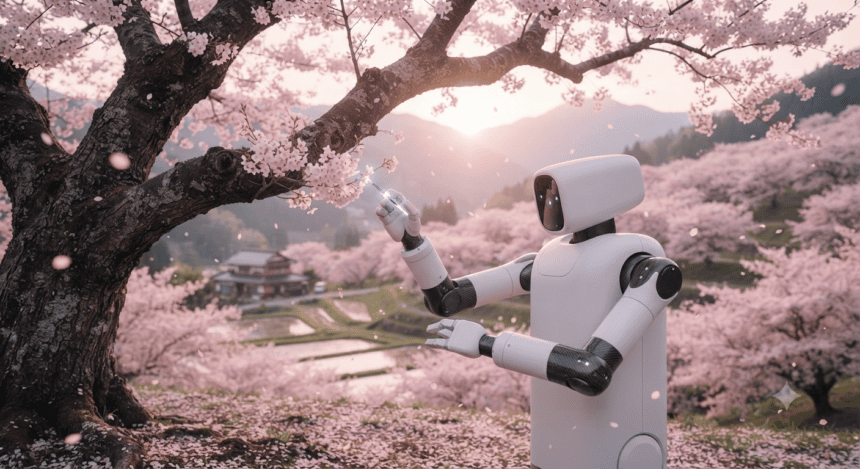
YAMANASHI, Japan — The iconic cherry blossom season is becoming a logistical nightmare. In the hills of Yamanashi, where the prized *sakura* trees form the backbone of a centuries-old agricultural industry, the workforce is disappearing. The average age of a farmer here now exceeds 70.
Labor shortages have reached a critical point. With fewer young people choosing to stay in rural prefectures, orchards are being abandoned at a rate that threatens the future of Japan’s most famous export.
Local growers are now betting on a high-tech solution. Small, autonomous robots are patrolling the groves, tasked with the delicate work of pruning branches and monitoring soil health. These machines, developed by a coalition of Tokyo-based tech firms and regional agricultural universities, are designed to navigate the uneven, sloped terrain that once kept automation out of the orchards.
The technology isn’t just about efficiency. It’s about survival.
“My son moved to Tokyo fifteen years ago,” said Hideo Tanaka, a 78-year-old orchard owner whose family has tended these trees since the Meiji era. “I don’t blame him. But when my back finally gives out, who picks the buds? The machines are the only ones left who want the job.”
The robots utilize a combination of LiDAR sensors and AI-driven image recognition to identify diseased wood and optimal budding sites. They don’t tire, they don’t retire, and they don’t require the strenuous physical labor that has driven a generation away from the fields.
However, the transition is far from seamless. The hardware is expensive, and many small-scale farmers view the initial investment as an insurmountable hurdle. Even with government subsidies, the cost of retrofitting an entire orchard for robotic navigation remains a heavy burden for families operating on thin margins.
Critics also point to a cultural loss. Farming in Japan has long been a tactile, generational transfer of knowledge. Replacing a farmer’s intuition with an algorithm risks stripping the soul from the craft. There is a palpable fear that the *sakura*—a symbol of fleeting beauty and cultural identity—will eventually be reduced to an industrial commodity managed by lines of code.
For now, the machines are a stopgap. They provide a vital lifeline to an industry gasping for air, but they aren’t a complete replacement for the human touch.
The next three harvest seasons will determine if these robots are a genuine solution or merely a final, expensive attempt to delay the inevitable decline of Japan’s rural heartland. As the blossoms begin to fall, the silence in the orchards is increasingly filled by the hum of electric motors.