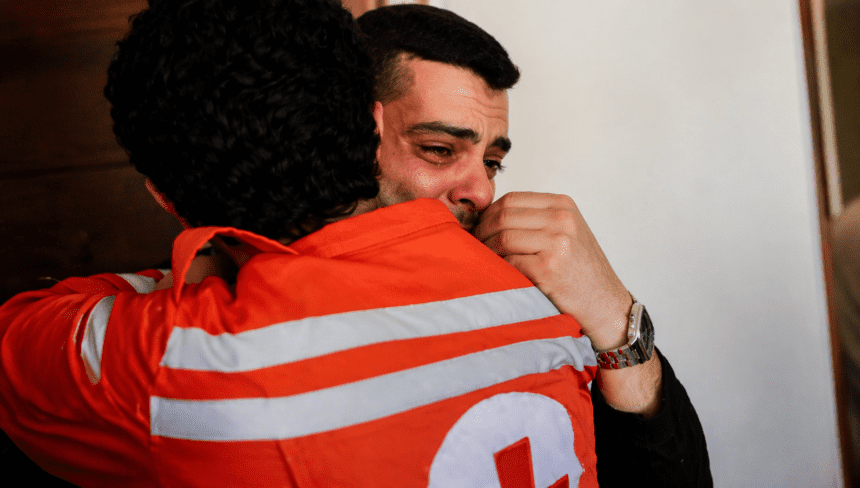
The phrase is blunt, but that is exactly why it has traction: a growing body of reporting and investigation says medics, paramedics, ambulance crews and rescue workers have repeatedly come under Israeli fire while trying to reach the wounded in Gaza and Lebanon. The pattern described in recent coverage is not only that health workers are being killed, but that some are being hit while responding to earlier strikes, turning rescue itself into a second battlefield.
One of the clearest cases remains the March 23, 2025 killing of 15 Palestinian aid workers in Rafah. A 2026 investigation cited by Al Jazeera said Israeli forces fired more than 900 bullets at ambulances and rescue vehicles and that some survivors were later executed. That account sharply deepened scrutiny of Israel’s conduct because the dead included Palestine Red Crescent, civil defense and UN personnel who had gone in to save lives, not to fight. Israel’s military has previously acknowledged serious failures in that incident, though rights groups and the victims’ organizations have rejected the official Israeli account as incomplete.
The issue is not confined to Gaza. In southern Lebanon this month, Associated Press reported that four Lebanese rescue workers were killed and six wounded in three consecutive Israeli strikes as emergency teams tried to aid wounded colleagues in Mayfadoun. The AP account, along with witness reporting from other outlets, described a sequence in which one team was hit, then follow-up crews arriving to help were struck as well. That is why some medics and observers have described the tactic as a “double tap” or even “quadruple tap.”
The wider numbers make the story heavier still. AP reported last week that since the Lebanon war reignited on March 2, at least 57 health professionals had been killed according to the Lebanese Health Ministry. Other recent reporting put the figure in a similar range and said attacks on hospitals, ambulances and medical infrastructure were compounding an already severe humanitarian crisis.
Israel, for its part, has often argued that armed groups such as Hezbollah use ambulances, hospitals or civilian facilities for military purposes, and the Israeli military said it was “looking into” the Mayfadoun strikes. But AP noted that in the recent Lebanon case, Israel had not publicly substantiated those claims. That gap — between the military justification and the evidence available to the public — is a central reason the issue keeps returning as both a legal and moral controversy.
The people who are supposed to arrive after the blast — to bandage, carry, revive and evacuate — are themselves ending up in the crosshairs. In that sense, the deeper story is not only about who is dying. It is about what happens to a war zone when the act of saving lives becomes one of the most dangerous jobs inside it.