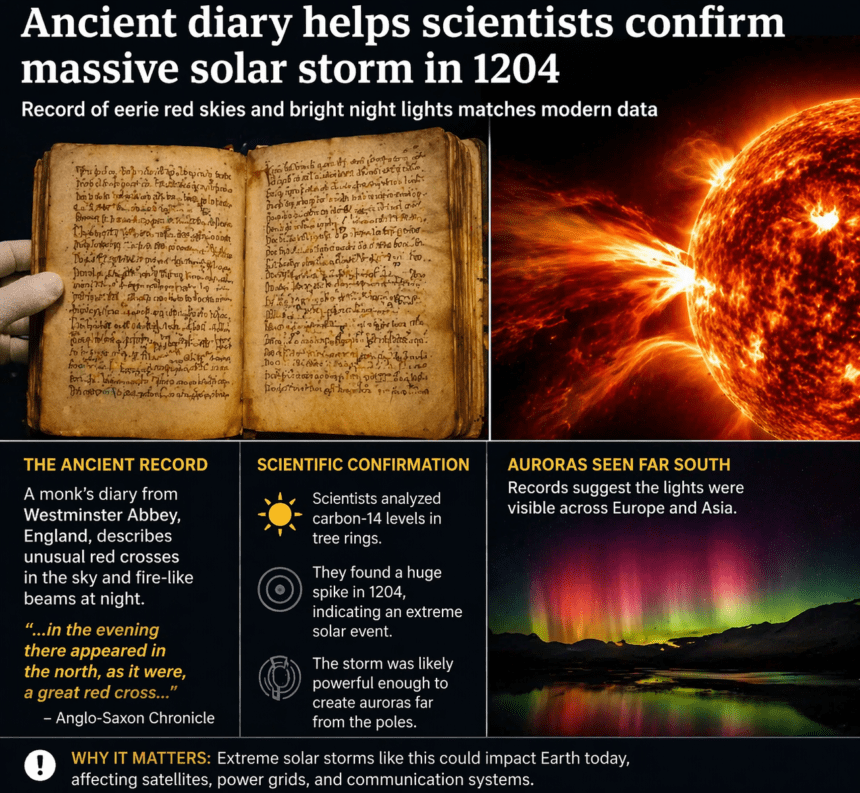
Scientists have used a medieval Japanese diary and ultra-precise tree-ring data to reconstruct a period of intense solar activity in the early 1200s, offering fresh insight into the kind of space weather that could threaten modern satellites and astronauts. The research, published on April 10, 2026, in the Proceedings of the Japan Academy, Series B, combines historical observations with carbon-14 measurements from buried trees.
At the center of the study is Meigetsuki, the diary of Japanese poet Fujiwara no Teika, who recorded mysterious red lights in the sky over Kyoto in 1204 CE. Researchers say those observations likely described auroras, evidence that the Sun was in a highly active phase during that era.
But the study’s main finding goes beyond the 1204 sky event. By analyzing annual carbon-14 changes preserved in ancient tree rings, the team identified a sub-extreme solar proton event around 1200–1201 CE. The authors say the event was smaller than the most severe known ancient solar storms but still powerful enough to matter for understanding radiation risks in space.
The researchers also found signs that solar cycles during the period from roughly 1195 to 1210 may have lasted only seven to eight years—shorter than the Sun’s modern average cycle of about 11 years. That suggests the medieval Sun may have been unusually active, a pattern that could improve models used to estimate future extreme space-weather risk.
The findings are important because solar proton events can expose astronauts and spacecraft to dangerous radiation. OIST said the newly identified event may have been more than 10 times larger than the February 1956 event, the largest solar proton event observed directly in modern times.