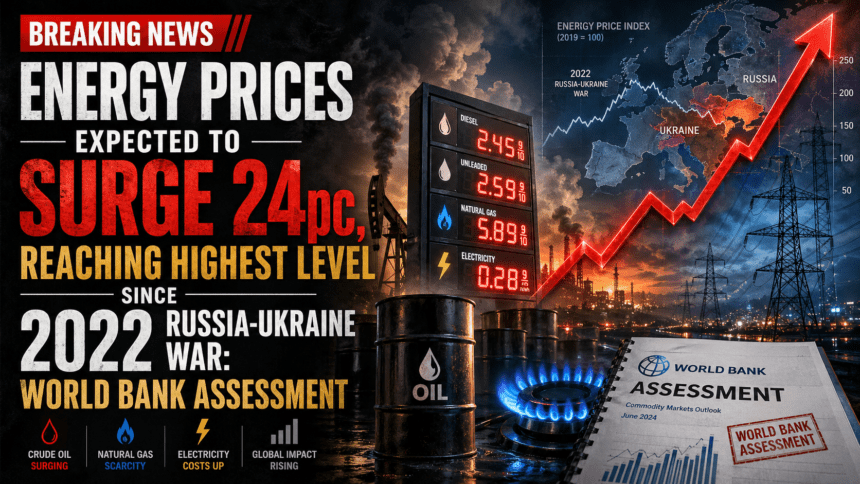
Global energy prices are expected to jump 24% in 2026, hitting their highest level since Russia’s invasion of Ukraine in 2022, according to the World Bank’s latest Commodity Markets Outlook. The bank says the main driver is the war in the Middle East, which has sent a fresh shock through commodity markets by disrupting supplies of oil, natural gas and fertilizer inputs.
The assessment does not stop at energy alone. The World Bank says overall commodity prices are forecast to rise 16% this year, reversing the decline seen after the earlier post-Ukraine-war spike and pushing the broader commodity index to its highest level in four years. The report also notes that several key metals are expected to remain at record or near-record highs, adding to the pressure on import-dependent economies.
A particularly serious concern is the knock-on effect on food systems. The World Bank warns that higher energy costs are making fertilizer more expensive and less affordable, a development that can raise farming costs, reduce yields and eventually push food prices upward. World Bank Chief Economist Indermit Gill said the shock is moving through the global economy in waves — first through energy, then food, and then inflation more broadly.
The bank’s baseline forecast assumes that the most acute phase of trade and shipping disruptions eases relatively soon and that volumes move back toward near prewar levels by October. Even under that less severe scenario, though, the World Bank says the Middle East conflict represents a historic shock to commodity markets and has caused the largest oil supply loss on record. That is why even a partial normalization would still leave prices well above earlier expectations.
For developing countries, the implications could be especially painful. Higher fuel and fertilizer prices tend to feed directly into domestic inflation, strain public finances, and squeeze household spending power, especially in economies already dealing with debt stress or weak growth. Recent coverage of the report says the World Bank expects poorer countries to bear a disproportionate share of the damage if elevated prices persist.
The new forecast also helps explain why energy markets remain on edge despite hopes that some disruptions could ease later in the year. Separate U.S. Energy Information Administration projections show Brent crude averaging well above pre-conflict levels in 2026, reinforcing the World Bank’s view that geopolitical risk is now a central driver of prices rather than just a short-lived spike.
Taken together, the World Bank’s message is stark: the world is facing its biggest energy price shock in four years, and the effects are unlikely to stay confined to oil and gas markets. If the pressure on shipping routes, fertilizer supply chains and fuel exports continues, the result could be slower growth, stickier inflation and deeper food insecurity across a wide swath of the global economy.