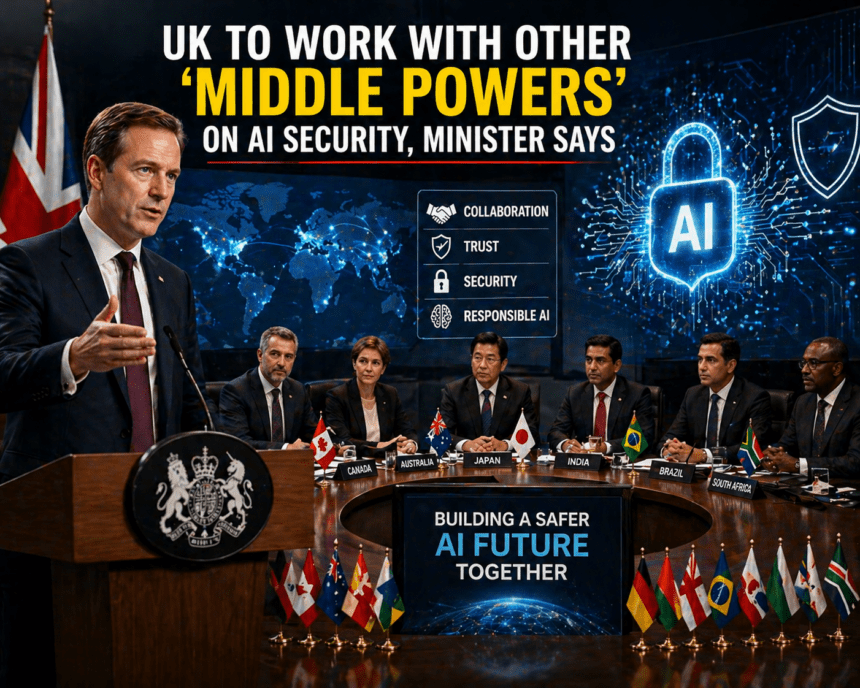
Britain will deepen cooperation with other “middle power nations” on artificial intelligence security and sovereign technology, Technology Secretary Liz Kendall said, as the UK tries to reduce dependence on a small cluster of foreign tech giants and build greater control over the systems likely to shape future economic and national power. In a speech at RUSI in London on April 28, Kendall argued that countries such as the UK need to work together if they want meaningful leverage in AI rather than being pushed to the sidelines by larger powers and dominant firms.
The message was not just about innovation. It was about security. Kendall said AI capability now sits alongside energy, defense, and critical infrastructure as a core strategic concern, and she linked Britain’s AI agenda directly to cyber resilience, industrial strength, and geopolitical independence. Her argument, in effect, is that the UK cannot treat AI as a normal technology market anymore; it has become part of statecraft.
That is where the idea of “middle powers” comes in. Britain is not trying to outspend the United States or China in a straight race for sheer scale, but it is looking for ways to pool influence with countries that have advanced economies, research strength and security interests of their own. Recent commentary around the speech framed this as an attempt to build alliances that make national tech systems more resilient to geopolitical pressure and less vulnerable to choke points in chips, compute and cloud infrastructure.
Kendall’s remarks also fit into a broader policy push already underway in London. The government launched a new Sovereign AI Fund on April 16, backed by £500 million, to help build British AI businesses, alongside a new Sovereign AI Unit intended to strengthen domestic capability in strategic parts of the sector. Ministers have presented that plan as essential not only for growth, but for national security and long-term leverage.
The security backdrop is hard to miss. In recent days, British officials have urged AI companies to help develop AI-powered cyber defenses, while the head of the National Cyber Security Centre warned that the most serious cyber threats to the UK now come from hostile states including Russia, Iran and China. That gives Kendall’s speech more weight than a standard tech-policy address. It suggests the government sees AI cooperation with allies and peers as part of a wider response to an increasingly hostile digital environment.
There is still a practical question, though: what exactly this cooperation will look like. Kendall’s speech points toward closer work on secure infrastructure, chips, investment and resilience, but the details of any formal grouping or joint framework remain unclear for now. Even so, the direction is plain enough. Britain is trying to carve out a position in AI that is neither passive dependence nor great-power imitation, but something more strategic — partnership among capable states that do not want to be left exposed in the next phase of the technology race.