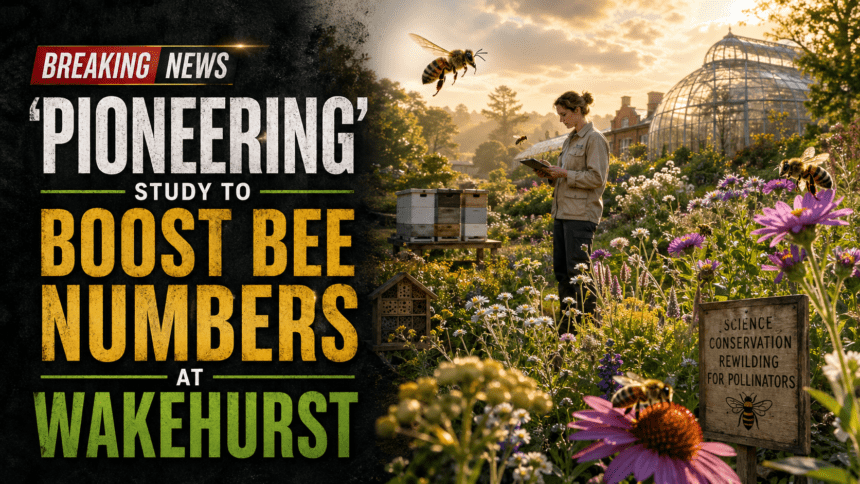
Wakehurst has launched what researchers describe as a pioneering study to find out which trees do the most to support bees and other pollinators, in a project that could help shape future planting in towns, cities and public landscapes. The Sussex site, known as Kew’s wild botanic garden, is using bioacoustic sensors attached to trees to detect pollinators by the sound of their wingbeats, allowing scientists to build detailed maps of where bee activity is strongest.
The project, called “The Buzz About Trees,” is based on a simple but important idea: trees may be playing a much bigger role in sustaining pollinators than many people realize. While wildflower meadows and garden plants often get most of the attention, researchers say trees remain relatively understudied as a food source for bees, especially in built-up areas where green space is limited.
By tracking sound patterns across different tree species, scientists hope to identify which trees attract the most pollinator activity and when. The eventual goal is practical, not just academic. If researchers can show that certain species are especially valuable for bees, that evidence could guide future decisions on urban planting, biodiversity strategies and habitat restoration.
The study arrives at a time of wider concern about insect decline in Britain. Researchers involved in the project have pointed to steep falls in flying insect populations over the past two decades, a trend that has raised alarms about pollination, food systems and ecosystem health. That gives the Wakehurst work a broader significance: it is not only a scientific experiment, but potentially a tool for helping reverse pollinator loss.
What makes the study stand out is the method. Instead of relying only on traditional field observation, the team is using sound technology to capture pollinator presence in a less intrusive and more continuous way. That could make it easier to study how bees use trees across seasons and landscapes, and it may open the door to wider monitoring projects in the future. This is an inference based on the project design described by Wakehurst.
If the findings are strong enough, they could influence more than gardening advice. They may help planners, councils and conservation groups decide which trees to plant not just for shade or appearance, but for their real ecological value. In that sense, the study is really about more than bees alone. It is about how the design of green spaces could quietly shape biodiversity for years to come.