DUBAI, April 29, 2026 — The United Arab Emirates is doing something that has become harder and harder in the Gulf over the past two months: it is trying to stand apart.
Since the Iran war erupted on February 28, Abu Dhabi has walked a narrow line. It has condemned Iranian missile and drone attacks on its territory, shut its embassy in Tehran, and insisted it reserves the right to defend itself. At the same time, it has kept repeating that it is not a party to the war and has not allowed its airspace, territory or waters to be used for attacks on Iran. That mix — tough language, limited engagement, and an obvious reluctance to be dragged fully into someone else’s fight — says a lot about where the U.A.E. sees its interests right now.
That position is not just about Iran. It is also about the U.A.E.’s increasingly complicated relationships with its neighbors, especially Saudi Arabia, and about a broader Emirati belief that survival in a fractured region now depends on flexibility, not bloc discipline.
The public messaging has been unusually direct. On January 26, the Emirati foreign ministry said the country would not allow its territory, airspace, or waters to be used in hostile military action against Iran, nor provide logistical support for such action. After Iranian strikes hit the U.A.E. and other Gulf states at the end of February, Abu Dhabi sharply raised the tone, calling the attacks a violation of sovereignty and international law. On March 1, it closed its embassy in Tehran and withdrew its ambassador and diplomatic mission. Two days later, it again stressed that it was not a party to the war, even as it asserted its right to self-defense. By April 8, when a two-week U.S.-Iran ceasefire was announced, the U.A.E. was publicly backing de-escalation and saying it was closely following the truce.
That sequence matters. It shows a country reacting to direct attacks, yes, but still trying to leave itself room. Abu Dhabi’s message, stripped of the diplomatic language, is fairly plain: don’t mistake restraint for alignment.
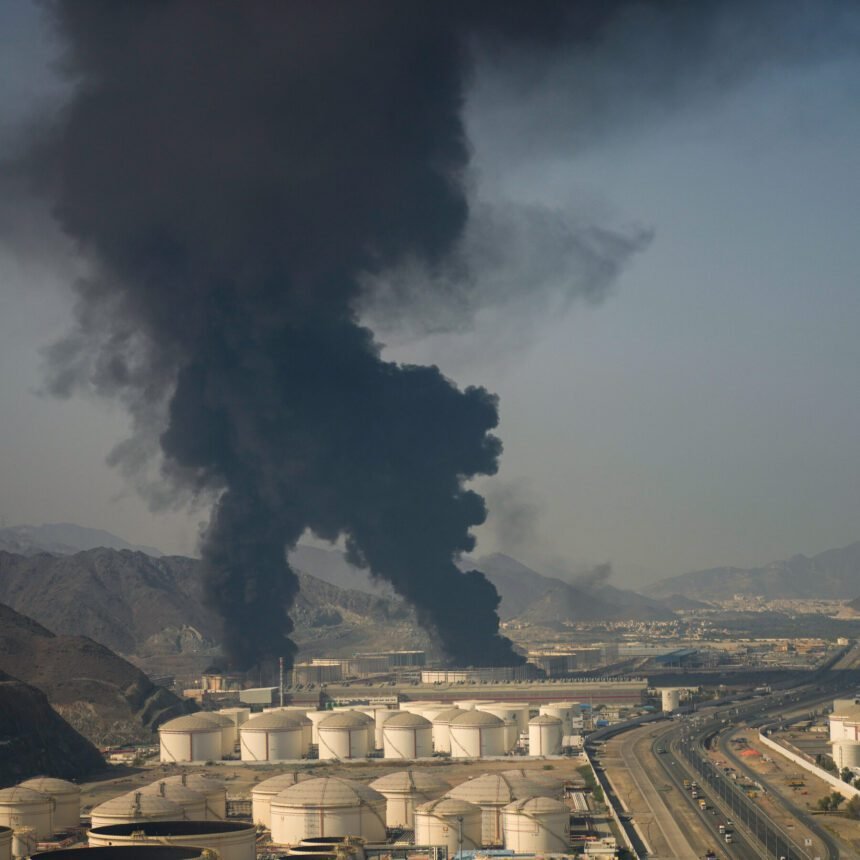
The war has made that balancing act harder because the U.A.E. was not spared. Analysts tracking the conflict say Iran’s retaliatory campaign hit Gulf states broadly, but the Emirates absorbed a particularly heavy share of the pressure, including repeated drone and missile threats to civilian and economic infrastructure. The Atlantic Council noted that Iran targeted the U.A.E. heavily in the early phase of the conflict, while the broader regional shock has already begun to reshape Gulf security thinking. The IMF, in its April regional update, described the war as a severe shock to one of the world’s most strategically important economic corridors, while welcoming the April 7 ceasefire as an important first step toward de-escalation.
And yet the U.A.E. has not folded itself neatly into a single Gulf front. That is where the neighbor piece comes in.
Saudi Arabia and the U.A.E. still share core interests — both are close U.S. partners, both want to contain instability, both are wary of Iranian power — but the relationship is not what it once was. Tensions have been building over Yemen, influence in the Red Sea, and competing ideas about regional order. Research from the Middle East Institute and the European Council on Foreign Relations describes a widening Saudi-U.A.E. rivalry in Yemen and the Red Sea basin, where each side has backed different local partners and pursued different strategic goals. Bloomberg, reporting in January, described the relationship as having reached a crisis point over Yemen.
Those strains are now showing up in energy politics too. On April 28, the Associated Press and The Washington Post reported that the U.A.E. would leave OPEC effective May 1, a major break with the Saudi-led oil framework that has anchored Gulf coordination for decades. The move was widely read as a sign that Abu Dhabi wants more freedom to set production policy on its own terms — and, maybe just as importantly, that it no longer sees automatic alignment with Riyadh as a strategic necessity.
None of this means the U.A.E. is pivoting toward Iran. It plainly is not. Closing an embassy is not symbolic housekeeping; it is a rupture. Emirati statements in March accused Tehran of aggression, warned of threats to regional peace and energy security, and made clear that missile attacks on civilian sites had crossed a line.
But neither is Abu Dhabi embracing the kind of all-in regional alignment that some of its neighbors might prefer. That is the real story here. The Emirates appears to be betting that in a Middle East this unstable, strategic ambiguity — measured, deliberate, a little frustrating to outsiders — is an asset.
There is also a domestic and economic logic to that approach. The U.A.E. has spent years selling itself as a safe commercial hub, a place where capital, shipping, aviation and diplomacy can still function even when the region is on edge. A prolonged war with Iran, or a perception that Emirati territory is simply an extension of someone else’s battlefield, cuts directly against that model. The pressure on infrastructure, shipping routes and investor confidence during this conflict has only sharpened that concern.
So Abu Dhabi’s posture can look contradictory from the outside. It condemns Iran, but emphasizes de-escalation. It supports self-defense, but rejects being cast as a frontline belligerent. It remains inside the Gulf security architecture, while also signaling — sometimes bluntly — that it will make its own calls.
That, more than any single statement, is what sets the U.A.E. apart at this moment. In a region where alliances are getting noisier and more brittle, the Emiratis are not exactly staying neutral. They are doing something subtler, and probably more durable: protecting room to maneuver.