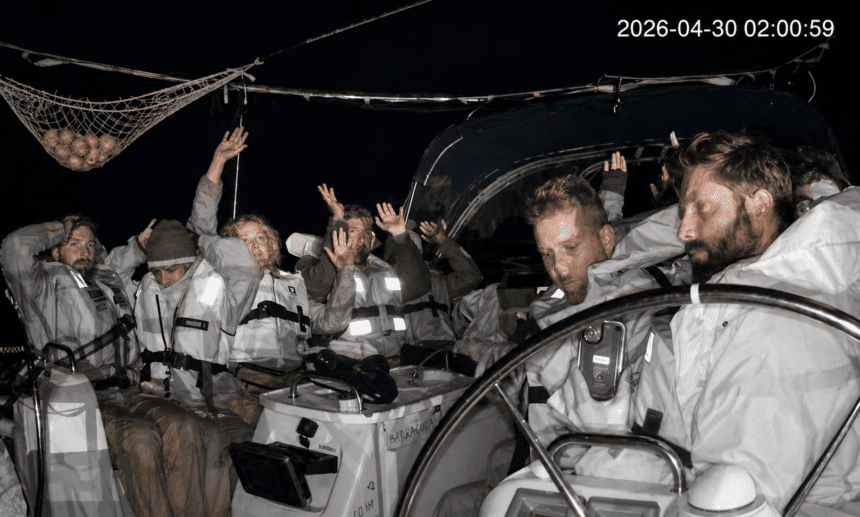
Israeli forces intercepted part of a Gaza-bound aid flotilla in international waters near the Greek island of Crete early Thursday, detaining crews from more than 20 vessels as the mission tried to challenge Israel’s long-running naval blockade of the enclave. Israel’s Foreign Ministry said about 175 activists were being taken to Israel, while organizers described the operation as a seizure of civilians far from Gaza itself.
The flotilla, known as the Global Sumud Flotilla, had set out from Barcelona earlier this month and was billed by organizers as one of the largest civilian attempts in years to deliver humanitarian aid to Gaza and draw attention to conditions inside the territory. Organizers said the campaign involved more than 70 boats and around 1,000 people from different countries, with additional vessels joining as it moved east across the Mediterranean.
What happened overnight was messy, fast-moving and, depending on who was speaking, either a security enforcement operation or a blatant act of piracy. Activists said Israeli forces moved in while the boats were still hundreds of miles from Gaza — near Crete and more than 600 miles from the Palestinian coast. By mid-morning Thursday, a tracker published by the group showed 22 vessels had been intercepted west of Crete, while 36 others were still sailing.
Israel has defended the interception by pointing to its blockade of Gaza, in place since Hamas seized control of the territory in 2007. Israeli officials say the naval restrictions are meant to stop weapons and other military material from reaching Hamas. Critics, including aid activists and rights advocates, argue that the blockade punishes Gaza’s civilian population and has become even harder to justify as shortages of food and medicine deepen.
That argument sits at the heart of this latest standoff. The activists say the flotilla’s purpose was humanitarian and political at the same time: to carry aid, yes, but also to force international attention back onto Gaza, where roughly 2 million people are still living amid widespread destruction and limited aid access. AP reported that only a small amount of aid was entering through a single Israeli-controlled crossing point, a reality flotilla organizers say underscores why symbolic sea missions keep resurfacing despite the risks.
Turkey reacted sharply. Its foreign ministry condemned the seizure as “an act of piracy” and said the operation violated humanitarian principles and international law. Turkish officials also said Foreign Minister Hakan Fidan discussed the incident by phone with his Spanish counterpart, underscoring how quickly the episode spilled beyond the Israel-Gaza file and into a broader diplomatic row.
There was criticism in Greece too. Activists in Athens said the interception took place inside the maritime zone where Greece holds search-and-rescue responsibility, and they accused Greek authorities of standing by while the flotilla was stopped. A protest outside the Greek foreign ministry was planned later Thursday.
The confrontation lands at a moment when Gaza remains under extraordinary strain even after the most intense fighting eased. According to AP, Gaza’s Health Ministry says more than 790 people have been killed in Israeli attacks despite the six-month-old ceasefire, and that the overall Palestinian death toll in the war has reached 72,300 since it began after the Hamas-led October 7, 2023 attack on Israel, which killed about 1,200 people, mostly civilians. Those figures remain central to the political fight over the blockade, the war, and outside efforts to challenge Israeli control over access to Gaza.
This was not the first attempt by the same activist network. A previous flotilla effort was also blocked, and Israeli officials had already signaled last year that they would not allow vessels linked to the campaign to break the naval cordon. In a September 2025 statement, Israel’s Foreign Ministry said it considered the flotilla unlawful and urged participants to unload any aid through Ashkelon for coordinated transfer into Gaza instead.
For now, the immediate picture is still shifting. Some activists were already in Israeli custody by Thursday morning, some boats had been stopped, and others were still at sea. But the broader point was plain enough: even far from Gaza’s shoreline, the war’s political and humanitarian shockwaves are still playing out across the Mediterranean.