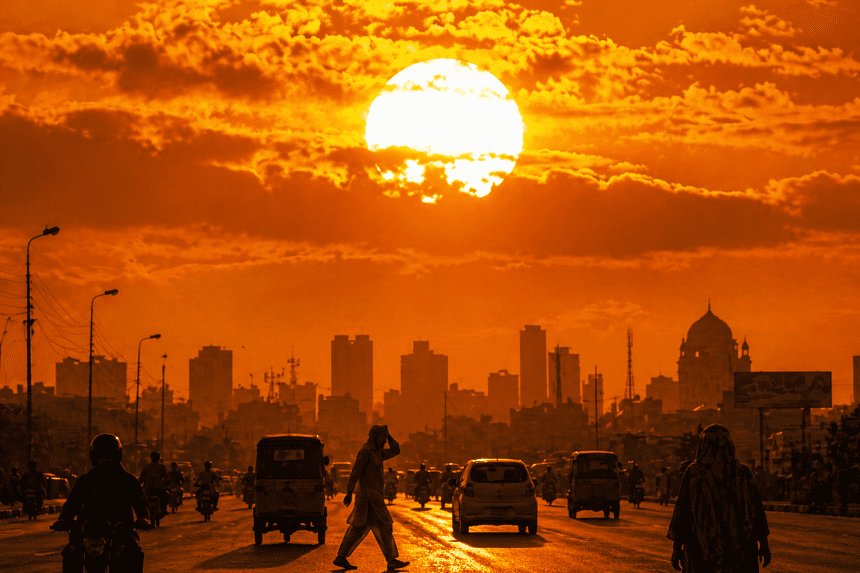
Karachi’s sea breeze died down Tuesday morning, pushing temperatures to 41°C and leaving millions across the city struggling under a relentless heatwave that shows no sign of breaking before the weekend. While the coastal capital bakes, the situation is grimmer in northern Sindh, where Jacobabad and Larkana are already reporting highs of 49°C.
The Pakistan Meteorological Department (PMD) issued a high alert, noting that the heat index—what the temperature actually feels like to the human body—is hovering near 47°C in Karachi due to 45% humidity.
The culprit is a high-pressure system over central Pakistan that has effectively “plugged” the cooling winds usually coming off the Arabian Sea. Hospitals across the province have been placed on standby. At Jinnah Postgraduate Medical Centre (JPMC) in Karachi, emergency wards are already seeing a steady trickle of patients showing signs of heat exhaustion and dehydration.
“We are telling people to stay indoors between 11 AM and 4 PM,” a senior registrar at JPMC told reporters during a shift change. “It’s not just the heat; the air is stagnant. Without the sea breeze, the city becomes an oven” The power grid is failing to keep up. Residents in Orangi Town, Surjani, and parts of Lyari reported unannounced load-shedding lasting up to six hours on Monday night.
K-Electric, the city’s sole power provider, attributed the outages to “increased demand and local faults,” but for those trapped in high-rise apartments without ventilation, the explanation offers little comfort. In the interior districts, the heat is more than an inconvenience—it’s a threat to the agricultural cycle.
In Sukkur and Ghotki, laborers have moved their shifts to the late evening and early morning hours to avoid the midday sun. The Sindh provincial government has directed school administrations to ensure functional fans and plenty of drinking water, though they stopped short of announcing an early summer break. The Met Office expects this “heat dome” effect to persist for at least another 72 hours.
Relief isn’t expected until a low-pressure system currently forming in the Bay of Bengal potentially shifts wind patterns toward the coast by Sunday. Until then, the province remains under a scorching standstill