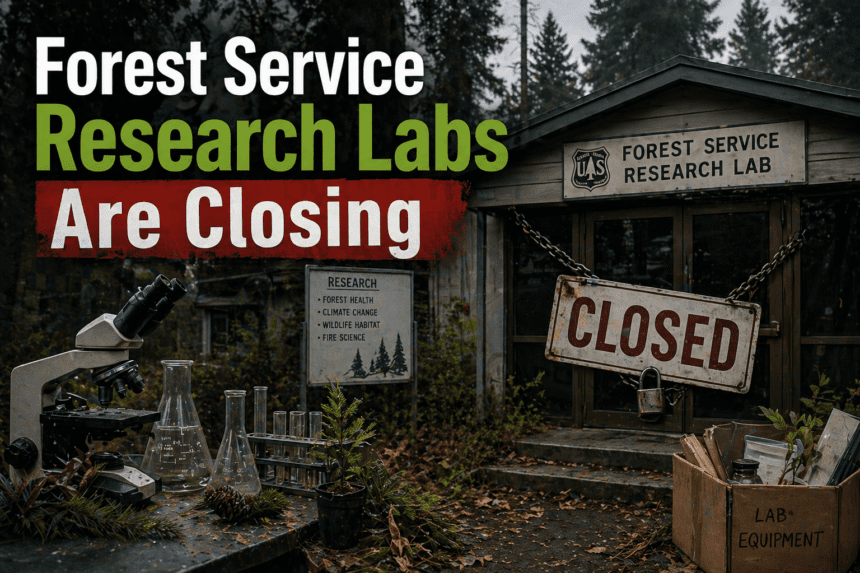
The U.S. Forest Service is moving ahead with a sweeping reorganization that will close 57 of its 77 research facilities across 31 states, a change that has alarmed scientists, fire experts and conservation groups who say decades of place-based research could be thrown into disarray. The plan also consolidates the agency’s research leadership in Fort Collins, Colorado, while shifting overall headquarters functions from Washington to Salt Lake City.
The administration says the overhaul is meant to streamline operations and bring leadership closer to the forests the agency manages. In its announcement, the USDA said the restructuring would unify research priorities, reduce duplication and improve mission delivery. Officials have also framed the broader move as part of a push to reorganize federal land-management work around a more state-based model.
But the backlash has been immediate. Recent reporting says researchers and outside experts fear the closures will weaken work on wildfire behavior, drought, pests, watershed health, timber production and climate impacts at exactly the moment those issues are intensifying. Critics argue that many of the affected labs are valuable not because they are interchangeable office space, but because they sit in specific landscapes where long-running field studies have been built over years, sometimes decades.
That concern is especially sharp in wildfire research. Stateline reported that foresters worry the closures could undercut national wildfire readiness as fire season approaches, while other outlets have highlighted the risk of breaking up teams that study how forests respond to heat, drought and changing weather patterns. In places such as Minnesota and Washington state, local coverage has focused on the possible loss of region-specific science tied to peatlands, forest carbon, smoke, and mountain ecosystems that cannot easily be replicated somewhere else.
There is also a staffing question hanging over the whole effort. Reports from employees and people close to the agency suggest many scientists may choose to leave rather than relocate or work through another disruptive reorganization, raising the possibility that expertise could walk out the door even before facilities are formally shut. The Forest Service has said more details will be released as they become available, but it has not fully answered how many research staff will move, how many positions may be lost, or how ongoing projects will be protected during the transition.
For supporters of the move, the argument is simpler: put managers and decision-makers closer to the land, cut bureaucracy and reshape an agency they say has grown too centralized. For opponents, it looks less like streamlining and more like a deep cut to the government’s scientific capacity at a time when forests across the country are under growing pressure. That tension is now at the center of the story — not just where the Forest Service will be based, but what kind of research backbone it will still have when the restructuring is done.