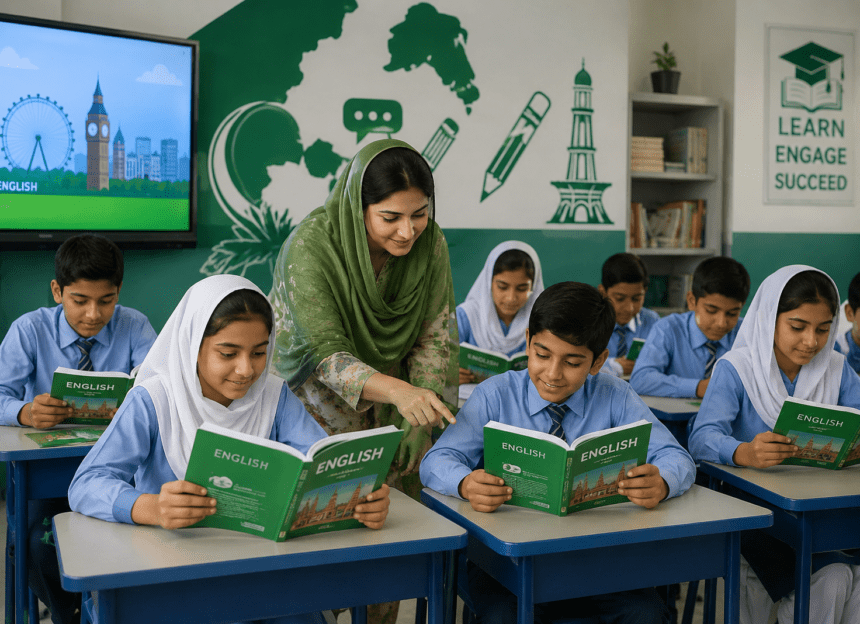
The Punjab government has launched a province-wide initiative to overhaul English language instruction in public schools, aiming to dismantle the barrier between elite private education and the state-run system. The program, titled “English for All,” focuses on shifting from rote memorization to conversational fluency for students in grades 6 through 10.
Education officials say the current system has failed to produce graduates capable of competing in the modern job market.
Students often finish school with high marks in grammar tests but lack the ability to hold a basic professional conversation. “We are tired of churning out students who can quote Shakespeare but can’t order a coffee or explain their resume in English,” a senior official at the Punjab School Education Department said. “The goal isn’t just marks; it’s employability.
” The initiative hinges on three pillars: mandatory teacher retraining, the introduction of digital language labs, and a revamped curriculum focused on functional communication.
Starting next month, 15,000 teachers will undergo a six-week intensive certification program developed in collaboration with international language experts. Critics, however, remain skeptical about the implementation.
Previous attempts to modernize the public school curriculum have often stalled due to a lack of infrastructure in rural districts. Many schools currently lack stable internet access, let alone the hardware required for the proposed digital labs.
The provincial government has earmarked an initial budget of 4 billion PKR for the project. While the funding covers textbooks and teacher stipends, the logistics of reaching schools in remote areas like Rajanpur or Dera Ghazi Khan present a significant hurdle.
“Training is fine, but you can’t teach a language in a room with no fans and forty students to a desk,” said a teachers’ union representative. “We need to see the infrastructure on the ground before we call this a success.
” The government plans to monitor progress through quarterly standardized speaking assessments rather than traditional written exams. Officials believe this shift will force schools to prioritize classroom participation over passive learning.
Whether this initiative becomes a genuine turning point or another bureaucratic exercise depends on the government’s ability to sustain the program beyond the initial rollout. For now, the policy marks the most aggressive attempt in a decade to reshape the classroom experience for millions of students.