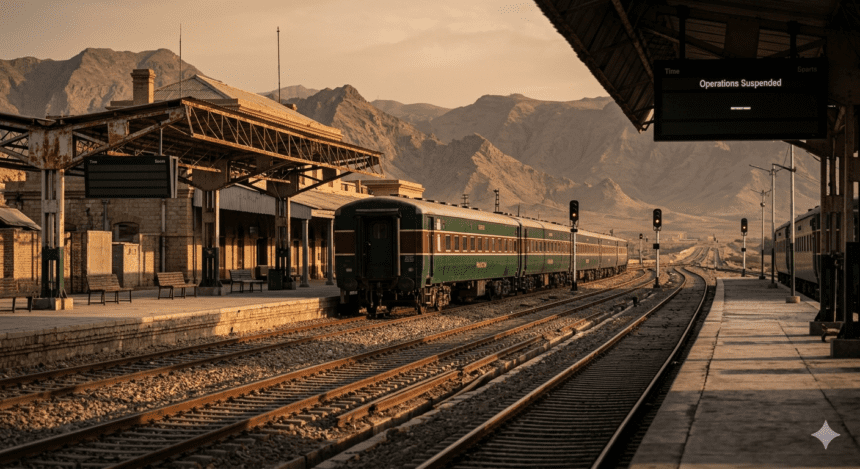
QUETTA / KARACHI — Railway services connecting Quetta to the rest of Pakistan have been suspended for yet another day, with officials continuing to cite “unavoidable circumstances” as the reason for the ongoing disruption. The halt, which has now stretched across multiple consecutive days, has left thousands of passengers stranded, disrupted daily commutes across Balochistan, and reignited urgent questions about the safety and future of rail infrastructure in one of Pakistan’s most volatile provinces.
The suspension comes in the wake of one of the deadliest terrorist attacks on railway infrastructure in recent Pakistani history — a tragedy that has shaken the nation and pushed authorities to take sweeping precautionary measures across all train routes originating from and arriving in Quetta.
Train services to and from Quetta and across parts of Balochistan remained suspended on Friday, with railway officials citing “unavoidable circumstances” for the disruption. The Jaffar Express from Quetta to Peshawar did not depart, while the return service from Peshawar to Quetta was diverted back from Jacobabad.
Railway authorities confirmed that train operations across Balochistan have remained suspended for the past two days, while the Bolan Mail and Chaman Passenger services to Karachi were already halted.
In total, three major rail routes are currently non-operational:
- Jaffar Express (Quetta–Peshawar): Suspended in both directions. Incoming trains are being turned back at Jacobabad.
- Bolan Mail (Quetta–Karachi): Already suspended prior to the latest round of disruptions.
- Quetta–Chaman Passenger Service: Halted and remains closed indefinitely.
This effectively means a complete shutdown of rail connectivity into and out of Quetta — a city that serves as the capital of Balochistan and a critical hub for trade, transport, and daily commuters.
The current suspension is directly linked to a devastating terrorist attack that took place on 24 May 2026 near Chaman Phatak in Quetta. At least 14 people were killed and 20 others were injured after a blast caused by a vehicle-borne suicide bombing tore through a shuttle train in Quetta. The provincial government confirmed with “profound grief and deep concern” that a train shuttle service near Chaman Phatak in Quetta was targeted in a vehicle-borne suicide bombing.
The explosion killed at least 47 people and injured 98 others. The train was carrying Pakistani security personnel and their family members from Quetta’s cantonment area to connect with the Jaffar Express. The Balochistan Liberation Army claimed responsibility for the attack.
The BLA identified the alleged bomber as 25-year-old Bilal Shahwani, a resident of Killi Sarde, and said he was a member of the Majeed Brigade. Pakistani security forces reportedly raided Shahwani’s home and detained several of his relatives. Security forces cordoned off the area after the explosion, and the district administration established a control room at the office of the Quetta deputy commissioner.
The suspension of Quetta services has triggered a broader chain of disruptions across Pakistan’s rail network. Several trains departing from Karachi also faced significant delays. The Tezgam departed at 1:30am instead of its scheduled 5:30pm, prompting passengers to protest at Cantt Station. The Sukkur Express, scheduled to depart at 11:30pm, had still not left by Friday morning.
Passengers at major stations have been left without clear information about when services will resume, and railway staff have struggled to manage the growing frustration of stranded travellers.
The May 2026 attack was not an isolated incident. The latest disruption adds to a pattern of repeated interruptions to rail traffic in Balochistan over the past two years. According to officials, train services in the province have frequently been halted because of terrorist attacks on railway infrastructure, security-related operations, and sabotage of tracks in remote areas.
A timeline of major incidents illustrates just how persistent this threat has become:
- November 2024: At least 32 people were killed and 55 others were injured in a suicide bombing at Quetta railway station. The Jaffar Express and the Bolan Mail were suspended for four days after the bombing due to security concerns.
- March 2025: At least six military personnel were killed and over 450 passengers of the Jaffar Express were taken hostage after the train came under attack from armed militants in Balochistan’s Mach area. The Baloch Liberation Army (BLA) claimed responsibility for the attack.
- May 2026: The latest suicide bombing near Chaman Phatak, killing dozens and injuring nearly a hundred.
The BLA was responsible for Pakistan’s largest terror attack of 2025 — when the Jaffar Express, a train travelling from Quetta to Peshawar, was hijacked in March. Hundreds of people were taken hostage from the train, which was carrying 400 passengers.
The Balochistan Liberation Army (BLA) is an armed Baloch separatist group which, apart from calling for an independent state, also strongly objects to large-scale Chinese investment in the region.
Pakistani officials and security analysts have long alleged that hostile intelligence networks linked to regional rivals seek to destabilize the country by supporting insurgent proxies and fueling separatist narratives. The BLA has escalated its operations significantly in recent years, increasingly targeting transportation infrastructure, security convoys, and public spaces.
The government has affirmed that such terrorist operations will not weaken the state’s resolve in confronting extremism, vowing to pursue those responsible for the attack and impose deterrent punishments upon them.
Railway services are a lifeline for Balochistan. Hundreds of thousands of people — workers, students, traders, and families — rely on trains as their primary and often only affordable means of long-distance travel. The Jaffar Express alone covers 1,632 kilometres between Quetta and Peshawar, passing through dozens of towns and cities across Balochistan, Sindh, Punjab, and Khyber Pakhtunkhwa.
With all major routes now suspended and no firm date given for resumption, the economic and social impact is mounting by the hour. Traders dependent on rail freight face losses. Passengers who booked tickets days in advance are stranded at stations or forced into far more expensive road travel. Families awaiting relatives are left uncertain and anxious.
Railway authorities have so far offered little beyond the phrase “unavoidable circumstances” to explain the continued suspension. Railway officials said that passengers have been informed about the situation, and a decision regarding the restoration of train services will be made after reviewing the conditions.
No concrete timeline for resumption has been announced, and officials have not publicly detailed what security measures are being put in place before services can safely restart. The absence of clear communication has added to passenger frustration and public concern.
The suspension of train operations to and from Quetta is more than a logistical inconvenience — it is a reflection of a deep and unresolved security crisis in Balochistan. Each attack, each suspension, each stranded passenger is a reminder that the conflict in Pakistan’s largest province remains alive, dangerous, and far from resolution.
As railway authorities assess conditions and security forces intensify operations in affected areas, the people of Balochistan and the thousands who depend on its rail connections are left waiting — hoping that the trains will run again, and that they will be safe when they do.