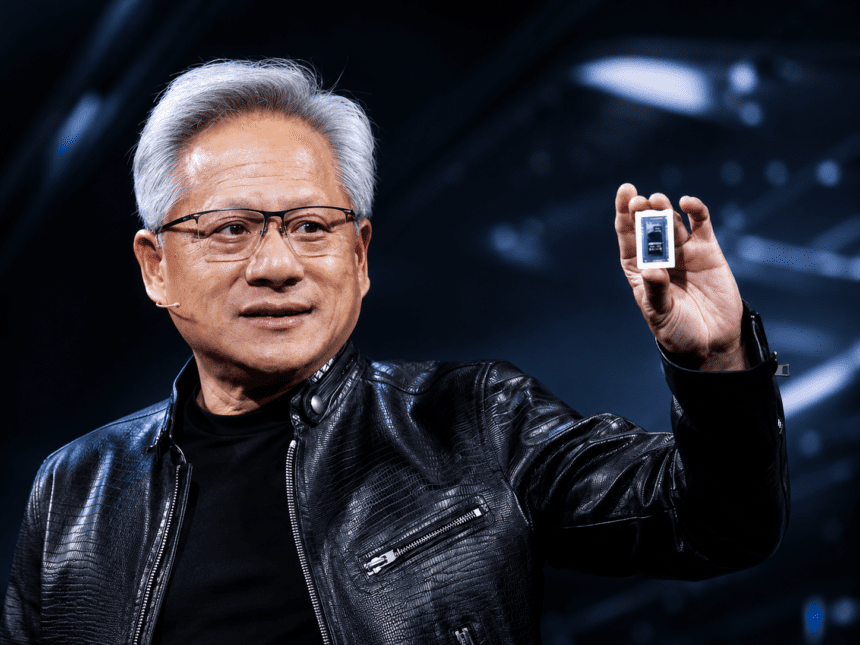
TAIPEI — Technology giant Nvidia on Monday unveiled a groundbreaking new processor designed to bring advanced artificial intelligence capabilities directly onto personal computers, directly challenging rivals AMD, Intel, and Apple in the rapidly evolving consumer hardware market.
Nvidia CEO Jensen Huang announced the new “RTX Spark” PC chip during a keynote speech ahead of the Computex conference in Taiwan, describing the release as a pivotal milestone in a three-year collaboration with Microsoft to completely reinvent the personal computer for the AI era. Developed in partnership with Taiwan’s MediaTek, the chip is scheduled to debut this fall in laptops and compact desktops from major manufacturers including Dell, HP, Lenovo, ASUS, Microsoft Surface, and MSI, with models from Acer and GIGABYTE expected to follow.
Industry experts note that the processor represents a fundamental shift in user engagement because it is engineered to run autonomous AI agents locally on the device rather than relying on remote cloud computing. Having already established dominance in the enterprise chips used to train massive AI models, Nvidia is now aggressively expanding into inference processors—chips that generate real-time AI responses to user queries and power background agents tasked with handling routine operations.
By targeting the mass PC market, Nvidia is leveraging its massive scale and AI expertise to unlock a lucrative consumer segment, reassuring investors amid deepening industry competition. While the initial market reception for AI-focused PCs has been mixed—with HP reporting strong quarterly sales and Dell noting that demand had fallen short of original projections—the move signals a massive industry pivot. Market analysts have compared the launch of the RTX Spark to seminal tech milestones like the debut of the iPhone, ChatGPT, or DeepSeek, predicting it will successfully transition the traditional application-centric PC into a highly integrated personal AI agent.
The announcement triggered a strong reaction on Wall Street, sending Nvidia shares up 4% and boosting Microsoft by 2.7%, while competitors AMD, Intel, and Qualcomm suffered stock declines between 4.9% and 8.5%.
The strategic emphasis on running localized AI agents on personal hardware was echoed by Qualcomm CEO Cristiano Amon, who also spoke ahead of the Computex trade show. Amon declared 2026 as the official turning point for agentic AI, explaining that the tech sector is rapidly moving past simple prompt-and-response tools toward fully autonomous assistants. He emphasized that this shift makes localized edge computing absolutely essential, as current device architectures were designed for user-initiated actions rather than always-on, autonomous agents.
Beyond consumer PCs, Huang devoted a significant portion of his address to Nvidia’s broader hardware roadmap, revealing that top-tier organizations such as OpenAI, Anthropic, and SpaceX have already become early adopters of the company’s new “Vera” central processor. Huang stated that the Vera CPU line grants Nvidia access to a massive new $200 billion market and will serve as the corporation’s next major growth driver.
Addressing widespread economic anxieties surrounding automation, Huang firmly dismissed concerns that artificial intelligence would eliminate jobs for software developers as “complete nonsense.” He argued that the technology acts as a productivity multiplier that will ultimately force companies to increase hiring to handle the influx of new software projects.
Highlighting the critical importance of the region, Huang praised Taiwan as the epicenter of the global AI revolution and announced plans to invest approximately $150 billion annually on the island. The high-profile address comes just two weeks after the CEO participated in a prominent corporate delegation alongside U.S. President Donald Trump during an official visit to Beijing to meet with Chinese leader Xi Jinping.