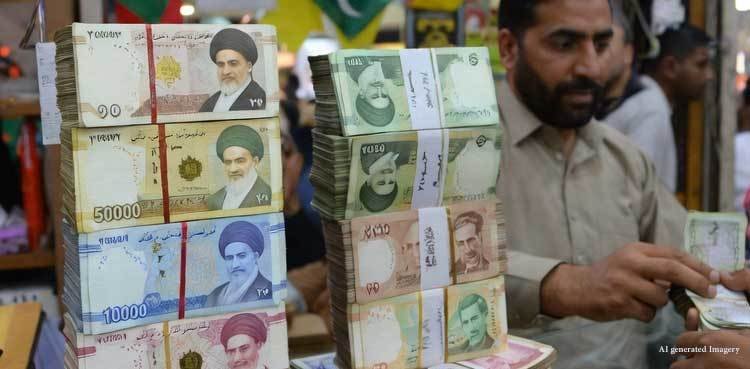
The Iranian rial remained an unusual outlier in Pakistan’s currency market on Monday, April 27, 2026, with local reporting saying one crore Iranian rials (10,000,000 IRR) was changing hands at around PKR 8,000 to PKR 10,000 in dealer networks in Karachi, Quetta and Lahore. That framing matters more than the tiny per-rial quote, because the rial is typically discussed in very large amounts in Pakistan’s market.
At the same time, online benchmark converters showed the Iranian currency at only a fraction of a Pakistani rupee per rial. One live conversion source put 1 IRR at about PKR 0.00021 on April 27, while Hamariweb’s recent tracker also showed the IRR near 0.0002 PKR.
That gap tells the real story. Pakistan’s quoted local-market price for bulk rial trades is far above the straight international benchmark, suggesting that the cross-border and informal market is being driven by factors beyond ordinary retail currency conversion. ARY’s report described the April 27 pricing as a premium in Pakistan’s informal market, while related reporting and recent market explainers pointed to border trade demand and limited formal settlement channels as key reasons the rial is being priced differently on the ground.
In practical terms, that means anyone looking at the Iranian rial in Pakistan needs to distinguish between two very different numbers: the global-style converter rate, which is tiny on a per-unit basis, and the actual local bulk-trade quote, where the market is speaking in crores of rials. Without that distinction, the pricing looks confusing, even contradictory.
For now, the April 27 picture is fairly clear: the Iranian rial is still being quoted at a strong premium in Pakistan’s local informal trade, even though online benchmark conversion tools continue to show a much weaker underlying rate. That makes it one of the more distorted currency stories in the market right now.