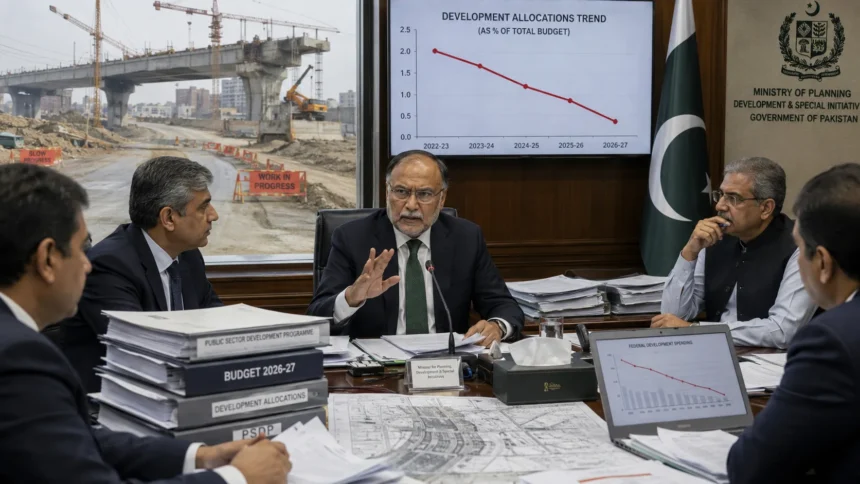
ISLAMABAD: Pakistan’s development spending for the upcoming fiscal year is facing a severe squeeze as the government moves to align Budget 2026-27 with International Monetary Fund conditions, leaving little fiscal space for new infrastructure and public-sector projects.
The pressure has intensified after the Ministry of Finance reportedly set the federal Public Sector Development Programme ceiling at Rs1.126 trillion, far below the development demands submitted by ministries. Planning Minister Ahsan Iqbal said federal ministries had sought around Rs4.097 trillion, creating an unmet requirement of nearly Rs3 trillion. As a result, several development schemes are likely to be delayed, shelved or left unapproved.
According to reports, the sharp gap between requested funds and available allocations reflects the government’s limited room for spending under the IMF-backed fiscal framework. Pakistan has committed to targeting an underlying primary balance of 2 percent of GDP in FY2027, a condition aimed at fiscal consolidation and debt sustainability.
The IMF programme has helped Pakistan stabilize its external position, but it has also required strict budget discipline, stronger revenue mobilization and tighter control over expenditure. The IMF Executive Board recently approved further access to funding for Pakistan under its ongoing arrangements, bringing total disbursements under the programmes to around $4.8 billion, while urging the country to maintain strong macroeconomic policies and continue structural reforms.
The development squeeze comes at a politically sensitive time, as the government faces pressure to revive economic growth, create jobs and complete long-delayed public projects. However, Planning Minister Ahsan Iqbal warned that with only Rs1.126 trillion available against demands exceeding Rs4 trillion, the government would have to make selective and difficult choices in project funding.
The funding shortfall is expected to affect new development initiatives most severely. Reports suggest the government will prioritize ongoing and strategically important projects, while fresh schemes may receive minimal allocations. Water, energy, transport and infrastructure projects are likely to compete for limited resources, with ministries being assessed on performance and urgency of completion.
Economists say the situation reflects Pakistan’s long-standing fiscal dilemma: the state must reduce deficits and satisfy lenders, but doing so often comes at the cost of public investment. Development spending is usually one of the first areas to be curtailed when the government attempts to meet primary surplus targets, because debt servicing, salaries, pensions, subsidies and defence expenditures leave little flexibility in the budget.
Pakistan’s development programme has already been under pressure in recent years. In FY2024-25, the federal government spent less than the originally approved PSDP allocation, highlighting weak implementation capacity and frequent downward revisions in public investment spending.
The latest budget exercise also shows that Pakistan’s fiscal recovery remains fragile. While tighter policies may help restore lender confidence and support macroeconomic stability, reduced development expenditure could slow infrastructure expansion and weaken long-term growth prospects. Public investment plays a critical role in roads, dams, universities, hospitals, energy networks and climate-resilient infrastructure — sectors that directly affect citizens and business productivity.
Officials argue that rationalizing the development portfolio is necessary because Pakistan can no longer afford to spread limited resources across hundreds of incomplete schemes. Ahsan Iqbal has previously warned that unchecked project liabilities could create a fresh circular debt-like crisis in the development sector, with old schemes consuming funds while new priorities remain unfunded.
The government is now expected to finalize Budget 2026-27 under close IMF scrutiny, balancing lender-backed fiscal targets with domestic demands for growth and relief. The final budget will show whether Islamabad can protect priority development projects while meeting its deficit and primary surplus commitments.
For now, the message from the budget process is clear: Pakistan’s next fiscal year will be shaped less by expansionary development ambitions and more by the hard limits of IMF-mandated fiscal discipline.