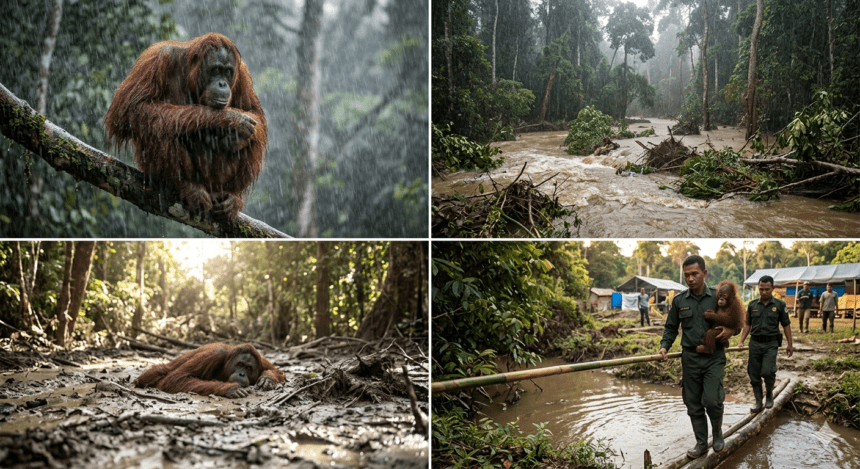
Four days of relentless rainfall in Indonesia’s Batang Toru forest have claimed the lives of 7% of the world’s rarest great ape species. New research confirms the Tapanuli orangutan—a population already numbering fewer than 800 individuals—is facing an existential threat from the very environment it calls home.
The study, published this week, links the deaths to catastrophic flooding and landslides triggered by extreme, unseasonal weather. While these apes have evolved to navigate the dense canopy of North Sumatra, the intensity of these storms overwhelmed their habitat, sweeping animals from the trees and destroying vital foraging grounds.
For a species this small, a 7% decline in less than a week is not just a statistical anomaly—it’s a demographic collapse. Biologists point out that with such a limited gene pool, the loss of dozens of breeding-age adults could stifle the population’s ability to recover for decades.
“We aren’t looking at a slow decline anymore,” said one lead researcher involved in the survey. “We are looking at a sudden, weather-driven erasure of a species that was already hanging by a thread.”
The Batang Toru ecosystem, the only home for *Pongo tapanuliensis*, has faced mounting pressure from hydroelectric projects and gold mining operations for years. Environmentalists argue that the fragmentation of the forest has left the orangutans with nowhere to retreat when the weather turns violent. When the mudslides hit, the apes were trapped in isolated pockets of trees, unable to move to higher, safer ground.
The data suggests that climate-driven weather volatility is now a primary driver of extinction for the Tapanuli. Even before these four days of rain, the species was classified as critically endangered. The loss of 7% of the population in one event effectively wipes out years of conservation efforts aimed at stabilizing their numbers.
Conservationists are now calling for an immediate moratorium on any further industrial encroachment in the region. They argue that if the forest continues to be carved up, the apes will lose the few remaining corridors they have to survive the next storm.
Whether the Tapanuli can bounce back from this remains an open question—but the window for intervention is closing faster than the data previously predicted.