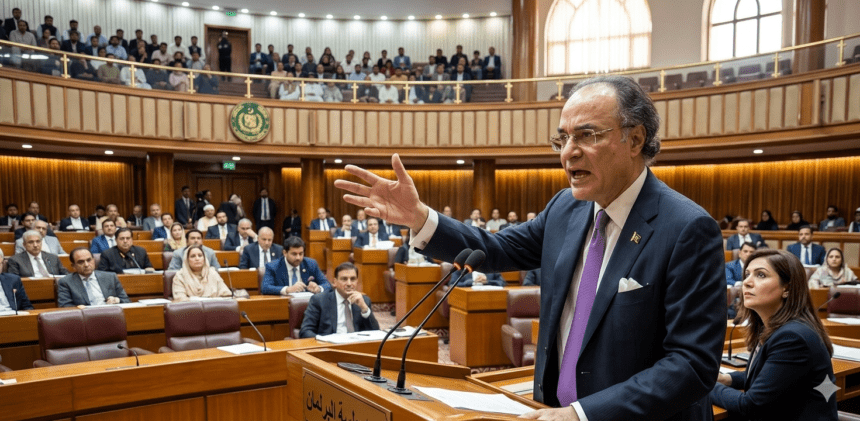
ISLAMABAD — The National Assembly on Sunday officially approved 12 critical demands for grants totaling Rs 4.282 trillion for the upcoming financial year ending June 2027, successfully bypassing intense legislative resistance by rejecting all 100 cut motions tabled by opposition lawmakers.
The fiscal demands were formally introduced to the floor by Federal Minister for Finance and Revenue Senator Muhammad Aurangzeb. The largest chunks of the multi-trillion-rupee allocations were directed toward servicing state overheads and structural financial obligations, prominently featuring Rs 2.504 trillion for grants, subsidies, and miscellaneous expenditure, alongside a massive Rs 1.162 trillion earmarked for superannuation allowances and pensions.
A detailed budgetary breakdown of the approved demands includes:
-
Taxation and Revenue: Rs 85.60 billion for the Federal Board of Revenue (FBR) and Rs 106 million for the Revenue Division.
-
Development and Loans: Rs 231.08 billion for general development expenditure, Rs 169.21 billion for domestic development loans and advances, and Rs 2.3 billion for external development loans and advances by the federal government.
-
Investments and Accounts: Rs 94.71 billion for federal miscellaneous investments, Rs 14.91 billion for the Controller General of Accounts, Rs 5.66 billion for core Finance Division operations, Rs 9.87 billion for other auxiliary expenditures of the Finance Division, and Rs 2.35 billion for capital outlay on federal investments.
Defending the allocations against sharp pushback from opposition Members of the National Assembly (MNAs), Finance Minister Aurangzeb pointed to a distinct upward trajectory in Pakistan’s primary economic indicators since 2022. He stated that national GDP growth has leveled to approximately 3.7 percent, backed by a historic primary fiscal surplus. Furthermore, the country’s current account recorded a sustained surplus over the previous year, maintaining that positive momentum through the first 11 months of the current fiscal year.
Addressing sovereign balance sheet concerns, the Finance Minister highlighted a strategic reduction in the country’s debt-to-GDP ratio, which successfully contracted from roughly 70 percent down to 68 percent. Aurangzeb reassured the house that upcoming revenue targets remain entirely achievable without the introduction of new tax burdens, explaining that the treasury’s focus has fundamentally pivoted toward rigorous enforcement and strict compliance.
The minister credited technology, process, and human resource overhauls at the FBR for tightening fiscal loops. He noted that long-pending litigation cases over the past two years have successfully yielded hundreds of billions of rupees in state recoveries. Concluding his address, Aurangzeb called for a unified national outlook to sustain economic stability and commended MNA Mobeen Arif’s prior performance on the Finance Committee, extending an open invitation for him to rejoin the legislative body.