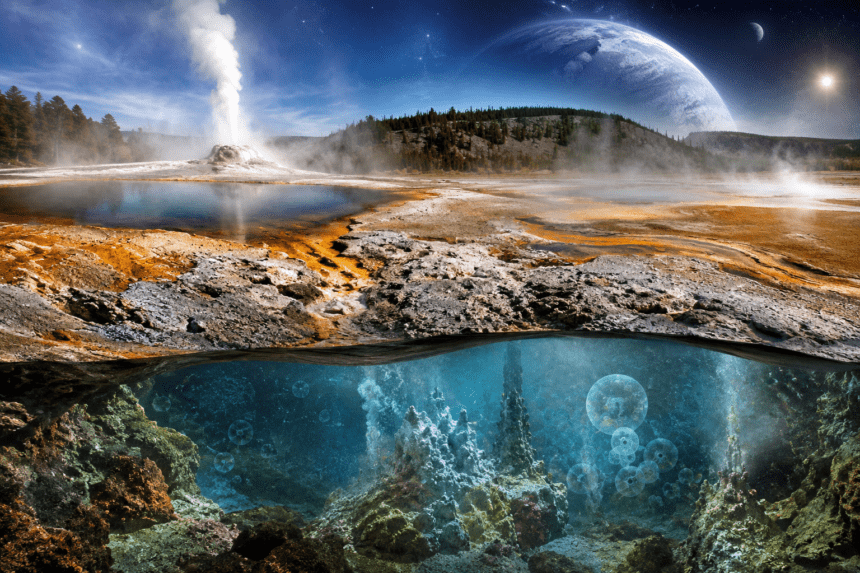
Yellowstone National Park’s hydrothermal pools are no longer just a tourist draw; they are serving as a terrestrial laboratory for astrobiologists hunting for signs of life beyond Earth. Recent findings suggest that the extreme, high-temperature, and acidic environments within the park mirror the conditions potentially found on icy moons like Europa or Enceladus.
Scientists are shifting their focus from liquid water alone to the specific chemical signatures left behind by extremophiles—microorganisms that thrive in conditions that would liquefy human tissue. By studying how these organisms metabolize sulfur and iron in Yellowstone’s vents, researchers are building a catalog of “biosignatures” that space probes could identify on other worlds.
“We aren’t just looking for water anymore,” says Dr. Elena Rossi, an astrobiologist involved in the study. “We are looking for the metabolic fingerprint of life that doesn’t rely on sunlight. Yellowstone provides the only accessible place on Earth where we can watch that process play out in real-time.”
The research centers on the park’s “geochemical heat engines.” These systems pump nutrient-rich fluids from deep underground, supporting complex microbial mats that function entirely independent of photosynthesis. If life exists in the subsurface oceans of Jupiter’s moon Europa, it likely operates on the same chemical principles found in the park’s Porcelain Basin.
Previous missions to Mars were often limited by a “follow-the-water” strategy. Data from Yellowstone is now forcing a pivot in that methodology. It suggests that the presence of hydrothermal activity—even in the absence of a stable surface atmosphere—could be enough to sustain a primitive biosphere.
NASA’s upcoming missions, including the Europa Clipper, will carry sensors calibrated to detect the specific isotope ratios identified in Yellowstone’s vents. The goal is to distinguish between geological noise and the chemical waste products of living organisms.
The park’s volatile environment remains a harsh, unforgiving place. Yet, for those looking for life in the dark corners of the solar system, the boiling mud pots of Wyoming are the best map we have. If life can carve out an existence here, the odds for the rest of the universe suddenly look a lot better.