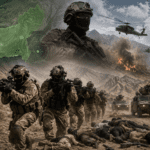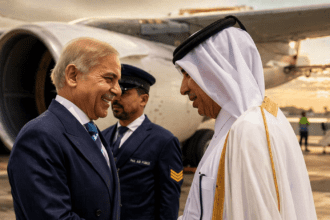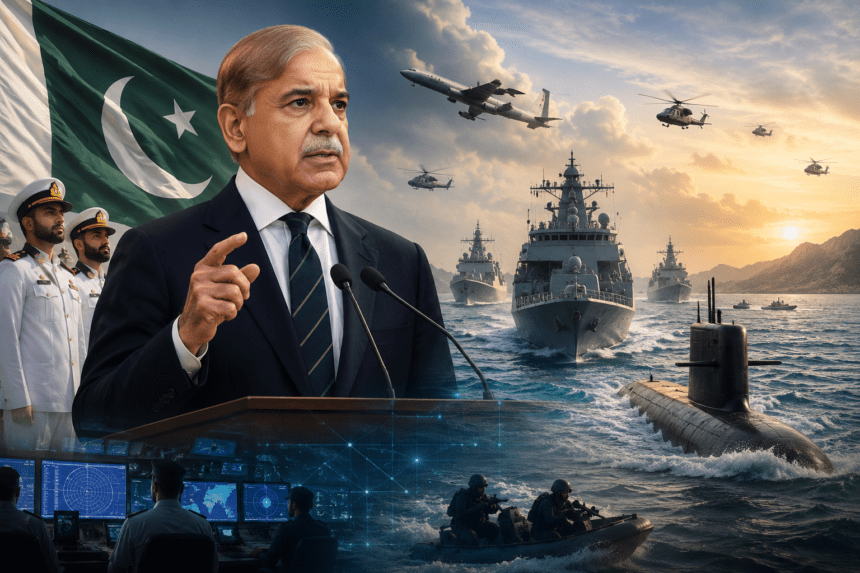
Prime Minister Shehbaz Sharif has directed the naval leadership to accelerate the modernization of Pakistan’s maritime defense, citing evolving regional security dynamics. During his visit to the Naval Headquarters in Islamabad, he emphasized that the country’s blue economy and sovereignty are inextricably linked to a “combat-ready” naval force.
The directive comes as Pakistan faces mounting pressure to secure its vast coastline, particularly in light of the ongoing expansion at Gwadar and the increasing volume of trade passing through the Arabian Sea. The Prime Minister’s focus, according to officials familiar with the briefing, centers on integrating artificial intelligence and indigenous drone technology into the current naval fleet.
“Our maritime interests are no longer confined to traditional patrols,” the Prime Minister told the assembled commanders. He acknowledged the fiscal constraints currently gripping the national budget but insisted that naval readiness remains a “non-negotiable priority” for the state.
The naval leadership presented a roadmap for the next decade, which includes the acquisition of advanced long-range maritime patrol aircraft and the domestic production of stealth-capable frigates. For the administration, the goal is clear: reduce reliance on foreign military hardware while increasing the speed of technological deployment.
Analysts suggest the push reflects a broader strategic pivot. With the Indian Ocean becoming a theater for heightened global competition, Pakistan is moving to ensure it doesn’t lose leverage in the region’s critical shipping lanes. The government is betting that a more visible and technologically capable naval presence will serve as a necessary deterrent.
The Prime Minister’s visit concluded with a closed-door session regarding the security of the China-Pakistan Economic Corridor (CPEC) sea routes. While the specifics of the discussion remain classified, the message from the top was blunt: the current pace of modernization must move faster to match the pace of regional changes.
The government now faces the challenge of balancing this military ambition against a fragile economy that has struggled to stabilize over the past eighteen months. How they fund these upgrades without further straining the public purse remains the defining question for the cabinet.