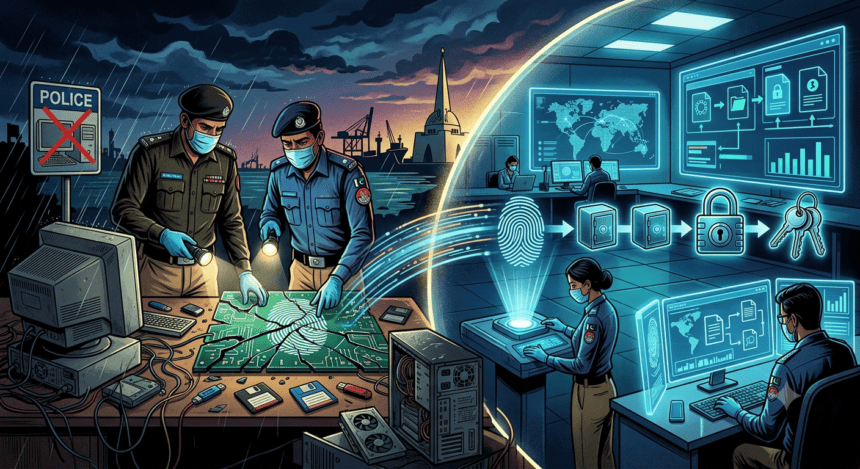
Sindh Police is intensifying its demand for a dedicated, state-of-the-art digital forensic laboratory, citing a massive backlog in evidence processing that is crippling investigations into organized crime and financial fraud.
Senior officers within the department confirmed that current protocols—which rely on shifting digital devices to federal agencies or external facilities—frequently result in months-long delays. For investigators, this time lag is often the difference between securing a conviction and watching a case collapse in court.
The push for the facility comes as Sindh faces a sharp rise in cyber-enabled crimes, ranging from identity theft to sophisticated digital extortion rackets. Officials familiar with the proposal note that the province’s reliance on third-party labs has left local detectives struggling to keep pace with the rapid evolution of digital evidence.
“We are fighting 21st-century crimes with 20th-century infrastructure,” one senior investigator said, speaking on condition of anonymity because he isn’t authorized to discuss the budget publicly. “When we seize a smartphone or a laptop during a raid, that device is effectively a black box for us. We can’t open it, we can’t extract the data, and we can’t wait six months for a report from another agency.”
The proposed lab would allow Sindh police to conduct its own data recovery, encryption analysis, and malware investigation in-house. Proponents argue this would not only speed up trials but also ensure a tighter, more secure chain of custody—a common point of contention for defense attorneys in high-stakes criminal cases.
While the provincial government has acknowledged the technical gap, funding remains the primary hurdle. The cost of acquiring specialized forensic software and hardware, combined with the need to train a dedicated cadre of cyber-experts, requires a significant upfront investment that has yet to be finalized in the provincial budget.
For now, detectives in Karachi and across the province continue to juggle a mountain of pending cases. Without a localized facility to process the digital breadcrumbs left behind by criminals, the department’s ability to secure justice remains tethered to the slow, bureaucratic pace of external forensic services.