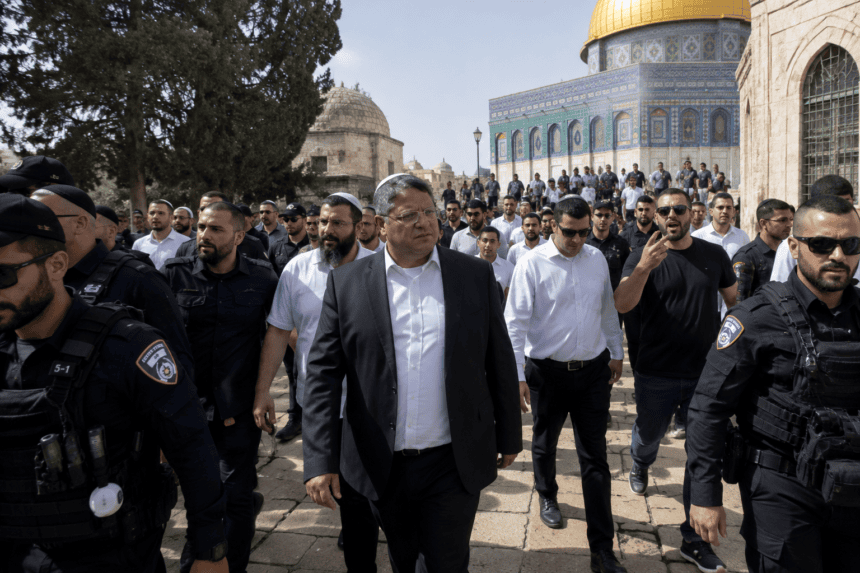
National Security Minister Itamar Ben-Gvir entered the Al-Aqsa Mosque compound on Tuesday, accompanied by hundreds of Jewish pilgrims and security personnel. The move marks another high-profile breach of the status quo at the contested site, a flashpoint that remains one of the most sensitive locations in the Middle East.
Ben-Gvir walked through the courtyards of the Haram al-Sharif, the site housing the Al-Aqsa Mosque and the Dome of the Rock, while supporters behind him recited prayers. Under long-standing international agreements, non-Muslim prayer is strictly prohibited within the compound. While Israeli police have long permitted “tours” for non-Muslims, the presence of a senior cabinet minister actively participating in religious rituals defies the delicate balance that has governed the site for decades.
The visit drew immediate condemnation from the Palestinian Authority, which described the act as a “provocation” intended to fuel regional instability. Hamas issued a statement calling the move a “blatant violation of sacred sites,” warning that such actions push the region toward an unavoidable escalation.
For many Palestinians, Ben-Gvir’s presence is not merely a visit; it is a signal of shifting policy. The minister has frequently campaigned on the right of Jews to pray openly at the site, a position that puts him at odds with the official stance of the Chief Rabbinate of Israel and the international community.
The Israeli police provided a heavy security perimeter for the group, clearing paths through the courtyards as onlookers watched from a distance. Tensions in Jerusalem have remained high since the outbreak of the war in Gaza, and security analysts warn that incursions into the compound often serve as a catalyst for wider unrest across the West Bank and beyond.
Despite the backlash, Ben-Gvir remained defiant, posting to social media during the visit that the site remains the “most important place for the people of Israel.” He ignored calls from moderate Israeli politicians to cancel the trip, citing the need to assert “sovereignty” over the area.
This latest incursion comes as international mediators continue to push for a ceasefire in Gaza. With the regional temperature already at a breaking point, the sight of a government minister leading a procession through the compound serves as a stark reminder that the conflict over Jerusalem remains the core of the broader struggle.