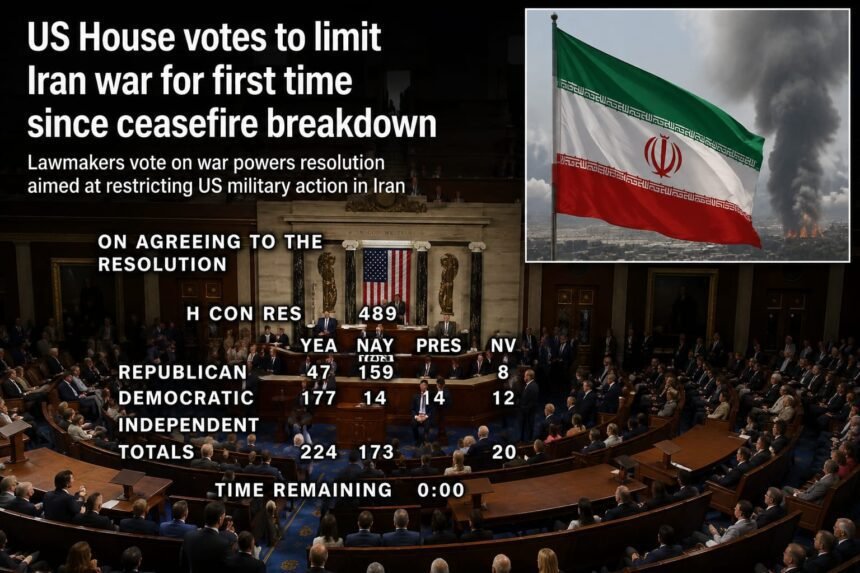
Washington, D.C. – July 23, 2026: The United States House of Representatives has voted to limit President Donald Trump’s authority to continue military operations against Iran without approval from Congress, marking the first successful House vote on the issue since the collapse of the ceasefire between the two countries.
The resolution passed by a 214–208 vote, with all Democrats and four Republican lawmakers supporting the measure. The legislation directs the president to halt unauthorized military action against Iran unless Congress explicitly approves further military operations. Although the vote represents a significant political rebuke, the resolution is largely symbolic because it is unlikely to become law without Senate approval and could also face a presidential veto.
The House action comes after the recent breakdown of a fragile ceasefire that had briefly reduced tensions between the United States and Iran. Fighting resumed following renewed airstrikes and retaliatory attacks, increasing fears of a wider regional conflict in the Middle East. The renewed violence has also raised concerns about global energy supplies and maritime security around the Strait of Hormuz.
Supporters of the resolution argued that the U.S. Constitution gives Congress—not the president—the authority to declare war. They said lawmakers must have a direct role in deciding whether the United States should continue military involvement in Iran. Critics of the administration also questioned the long-term strategy, the growing financial cost of the conflict, and the risk of further escalation.
Republican leaders opposed the measure, saying President Trump needs flexibility to respond quickly to threats posed by Iran and its allied groups. They argued that limiting the president’s military authority could weaken U.S. national security during an ongoing conflict.
A similar measure in the U.S. Senate failed to advance after a narrow procedural vote, highlighting deep political divisions in Congress over the Iran conflict. As a result, President Trump’s military authority remains unchanged for now, despite growing bipartisan concern over the prolonged war.
The House vote signals increasing congressional scrutiny of U.S. involvement in Iran and reflects rising public debate over the future of American military engagement in the Middle East.