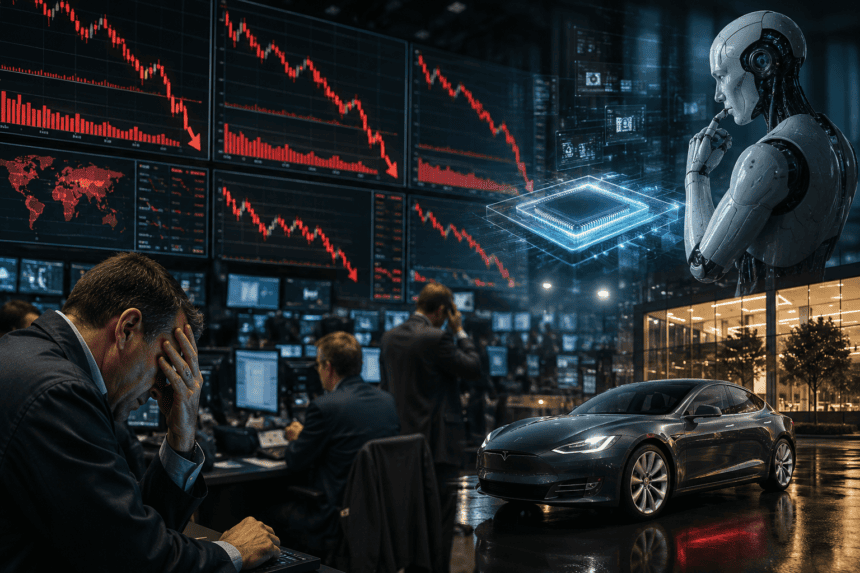
Wall Street hit a wall Wednesday. Investors turned on tech giants, stripping billions from the market caps of Google’s parent company, Alphabet, and Tesla. The sell-off follows a wave of aggressive capital expenditure reports that left shareholders questioning if the massive bet on artificial intelligence is worth the price tag.
Alphabet stock slid 5% in early trading. Despite beating earnings expectations, the company’s capital expenditure jumped to $13 billion for the quarter. That’s a massive cash burn—and it’s aimed almost entirely at building the data centers and chips required to power Gemini and other AI models.
Tesla took a harder hit. Shares dropped nearly 12% as investors reacted to a chaotic earnings call. CEO Elon Musk’s focus remains locked on autonomous driving and humanoid robots, but the immediate reality is a shrinking profit margin. Tesla’s margins have tightened as the company slashes vehicle prices to keep sales moving in a cooling EV market.
The market mood has shifted from “growth at any cost” to “show me the money.” For months, the promise of AI sent tech valuations into the stratosphere. Now, institutional investors are asking for a return on that investment. They aren’t seeing it yet. Revenue growth at Google’s core search business is steady, but it isn’t moving fast enough to offset the billions pouring into infrastructure.
“The market is finally doing the math,” said one senior analyst who tracks big tech. “They’ve spent two years buying the dream. Now they’re looking at the balance sheets, and the cost of the AI arms race is starting to bite into the bottom line.”
The volatility isn’t limited to just these two companies. Microsoft and Meta—both heavy spenders in the AI space—also saw their shares dip in sympathy. The fear is that the entire sector has entered a period of diminishing returns, where the cost of maintaining the AI infrastructure far outweighs the immediate revenue generated by the software.
Tesla’s situation presents a specific, different kind of risk. Musk has pivoted the company into an AI play, effectively telling investors to ignore the current auto-sales slump in favor of a future dominated by robotaxis. Wednesday’s sell-off suggests that patience is wearing thin. Wall Street wants to see profit from cars today, not just a promise of AI-driven autonomy tomorrow.
The tech rally that defined the first half of the year is cooling rapidly. As the earnings season continues, the pressure will be on other tech leaders to prove their spending is a bridge to profitability—not a bottomless pit.