The geography of education in Afghanistan has shifted from classrooms to living rooms. Since the Taliban’s return to power in August 2021, the ban on secondary education for girls has pushed thousands of students into a sprawling, underground network of clandestine schools.
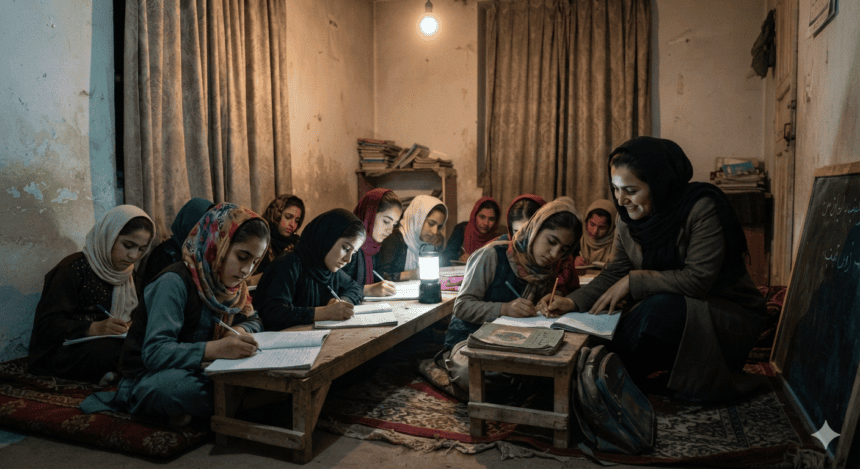
These are not state-sanctioned institutions. They are private homes, basements, and backrooms where teachers risk imprisonment to keep the curriculum alive.
The risk is constant. Taliban patrols frequently monitor neighborhoods, looking for signs of student gatherings. To avoid detection, girls often hide their textbooks under their burqas, arriving at “class” in staggered groups to avoid drawing attention to a single house. The curriculum is stripped down — math, science, and English are taught in whispers. If caught, the consequences for the teachers and the families involved are severe, ranging from detention to physical intimidation.
“We are not just teaching subjects; we are teaching survival,” says a former teacher who now runs a small group of five students in Kabul. She asked to remain anonymous, knowing that even a mention of her location could trigger a raid. “When a girl learns to read, she learns to question. That is why they are so afraid of us.”
International observers note that while the Taliban has periodically hinted at reopening schools, the policy remains rigid. The Ministry of Education has repeatedly cited “cultural requirements” and the need for a “proper environment” as reasons for the continued exclusion of girls. Yet, the reality on the ground contradicts these official statements. The demand for education has only intensified.
Digital learning has become the second front in this battle. Despite the lack of reliable electricity and internet access in many provinces, girls are increasingly turning to online platforms. VPNs are used to bypass government-imposed censorship, allowing students to access university-level courses hosted by NGOs based in the West. It’s a fragile connection—dependent on a battery charge and a stable signal—but it serves as a lifeline for those unable to risk physical travel.
The psychological toll is mounting. Students speak of a “lost generation”—a term echoed by aid workers who see the rising rates of depression and anxiety among teenage girls. Without a path to university or a career, many feel their futures have been erased.
For the families hosting these secret schools, the motivation is simple. They aren’t looking for a political revolution; they are looking for a way to ensure their daughters aren’t confined to a life of domestic invisibility.
As the ban approaches its fourth year, the underground network shows no signs of dissolving. The teachers are determined. The students are hiding their books, adjusting their veils, and waiting for the next lesson to begin. They know the risks, but they also know that for now, the only way to reach a future is to build it in the shadows.