WASHINGTON: President Donald Trump’s renewed push to expand nuclear energy in the United States and abroad, including a landmark civil nuclear agreement with Saudi Arabia, has triggered political and ethical scrutiny over whether members of his family and several close allies could financially benefit from the administration’s policies.
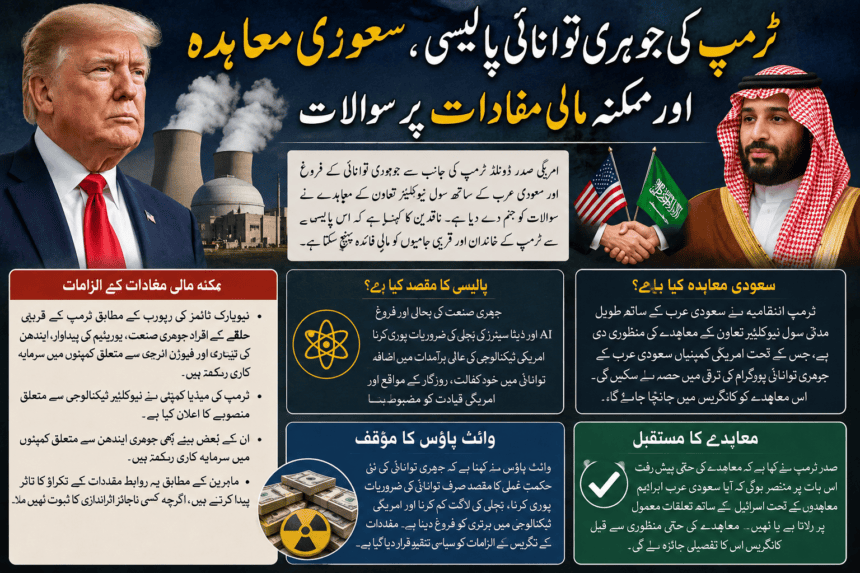
The Trump administration recently approved a long-term civil nuclear cooperation agreement with Saudi Arabia that could pave the way for American companies to help develop the Kingdom’s nuclear energy sector. The deal is expected to face congressional review amid concerns over nuclear non-proliferation and regional security.
The agreement is part of a broader White House strategy to revive the U.S. nuclear industry, increase electricity generation to meet growing demand from artificial intelligence and data centers, and expand American nuclear technology exports worldwide. Officials argue the initiative will strengthen U.S. energy security, create jobs, and reinforce America’s leadership in advanced nuclear technology.
However, a report by The New York Times, cited by multiple outlets, says several individuals within Trump’s political and business circle have investments or business interests in companies connected to the nuclear sector. These include firms involved in reactor construction, uranium production, nuclear fuel technologies, and emerging fusion energy projects. Trump’s media company has also announced plans involving a nuclear technology venture, while some of his sons reportedly hold investments in companies linked to nuclear fuel development.
Critics argue that these overlapping financial interests create the appearance of potential conflicts of interest, even though no evidence has emerged that Trump or his family improperly influenced the Saudi nuclear agreement for personal gain. Ethics experts say such relationships warrant close public and congressional oversight as the administration advances major energy policies.
The White House has strongly rejected allegations of improper conduct. A spokesperson said the administration’s nuclear strategy is designed to expand reliable electricity production, lower long-term energy costs, and support American technological leadership, dismissing claims of conflicts of interest as politically motivated.
Meanwhile, the Saudi agreement itself remains politically contentious. While the administration has promoted it as a strategic partnership, President Trump later stated that the deal would ultimately depend on Saudi Arabia normalizing relations with Israel under the Abraham Accords, adding uncertainty to its future. The agreement will now undergo congressional scrutiny before taking effect.