Rothamsted Research in Hertfordshire, England, holds the world’s oldest continuous ecological experiment. Since 1856, researchers have monitored the Park Grass trial, a modest plot of land that has survived two world wars, shifting agricultural policies, and a changing climate.
What began as a Victorian-era investigation into how fertilizers affect crop yields has evolved into a massive, living database on biodiversity and soil health.
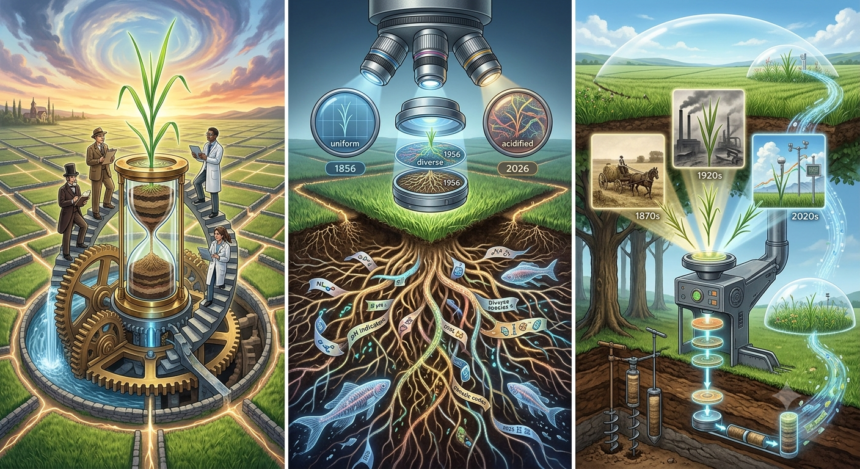
The experiment’s longevity is its greatest asset. Most scientific studies run for three to five years, often ending just as the initial funding dries up. By maintaining the same plots for 170 years, Rothamsted scientists have captured long-term shifts that short-term observation misses entirely. They’ve tracked how specific grass species thrive or vanish depending on the soil’s acidity and nutrient levels, providing a window into how ecosystems respond to long-term environmental stress.
In the early years, the focus was purely practical: increasing productivity for a growing population. Today, the data tells a different story. It tracks the migration of plant species in response to rising temperatures and shifting rainfall patterns. It serves as a real-world baseline for understanding how intensive farming practices alter the chemistry of the earth beneath our feet.
The plots themselves are divided into sections receiving different treatments—some get nitrogen, some phosphorus, some nothing at all. This consistency allows researchers to isolate variables with precision that would be impossible in a modern, fluctuating landscape.
While the tools have changed—from manual ledger books to satellite imagery and genomic sequencing—the core mission remains unchanged. The trial has survived because it answers a fundamental question that remains relevant regardless of the decade: how do we balance the demand for food with the limits of the land?
As climate change accelerates, the Park Grass experiment offers more than just historical curiosity. It offers a warning. The data shows that biodiversity in these plots has plummeted in areas with high fertilizer use, suggesting that the drive for yield has a hidden, long-term cost to the resilience of the ecosystem.
For the researchers currently managing the site, the experiment is a marathon that never ends. They aren’t just observing grass; they are documenting the slow-motion reaction of the natural world to human intervention, one season at a time.